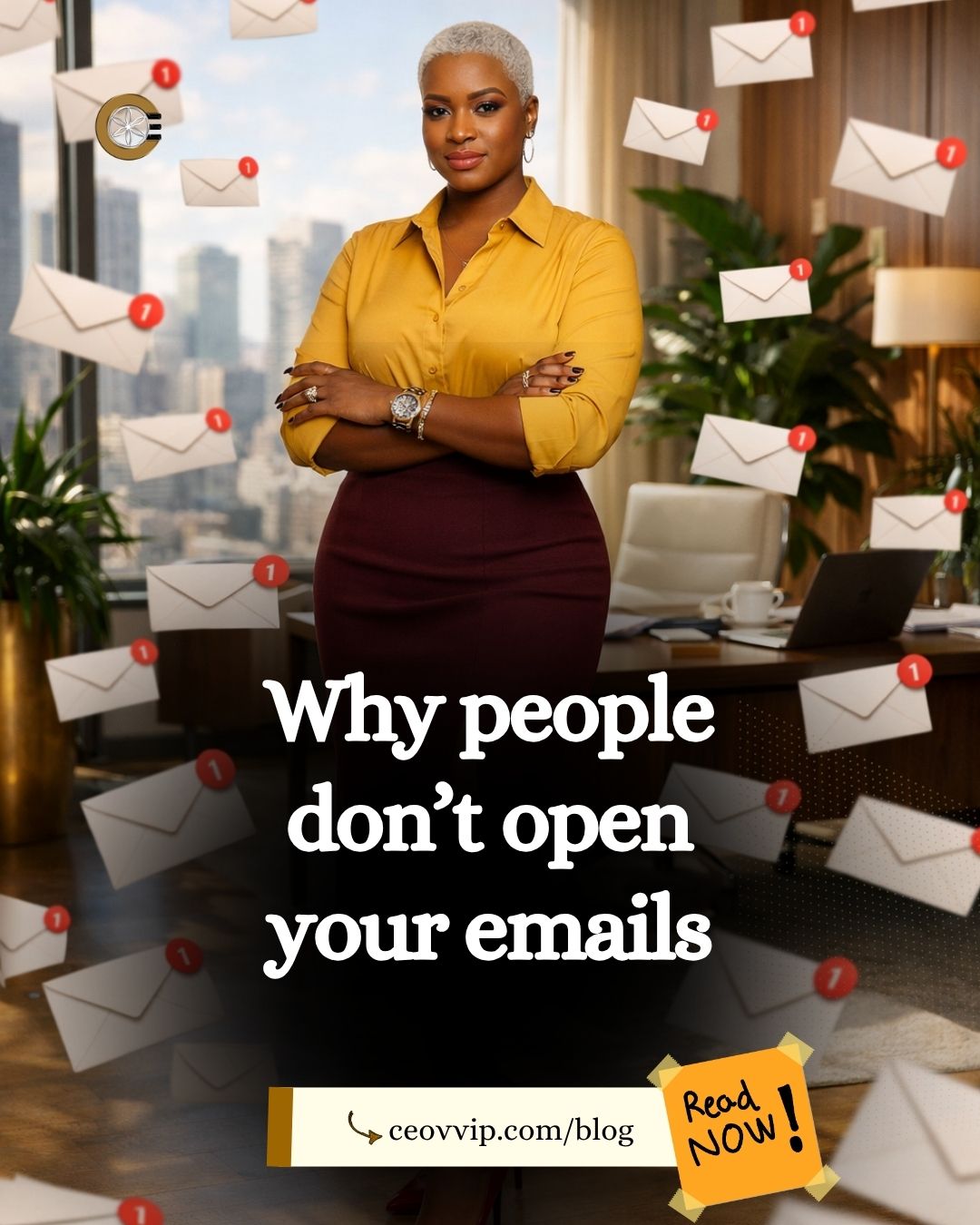
The Real Meaning Behind Unopened Emails
There is a particular kind of frustration that sits behind most email dashboards, especially when you open your analytics expecting one story and the numbers tell you another. You look at your open rates, notice the gap between what you hoped for and what actually happened, and almost immediately, your mind goes to the same place. Why are people not opening my emails?
It is an understandable reaction, but it is also where many people begin interpreting the data too emotionally. Low open rates can feel personal. They can make it seem as though your audience is uninterested, your messaging is failing, or your offer has somehow lost its value. In reality, unopened emails rarely mean what people assume they mean, and the sooner you understand that, the more strategic your email marketing becomes.
You Are Not Seeing Their Full Reality
One of the first and most useful shifts you can make is recognising that you are not the centre of your audience’s day. That is not a criticism. It is simply the truth of how attention works. People are not sitting still, waiting to assess whether your email deserves their time. They are moving through their own lives, often with far more going on than your dashboard can ever show you.
They are dealing with deadlines, family responsibilities, financial pressure, mental fatigue, internal uncertainty, and the general noise of everyday decision-making. That means even when your offer is genuinely relevant, helpful, or well-timed in theory, opening your email may still require a kind of energy they do not have in that moment. Once you accept that, the emotional charge of feeling ignored begins to soften. What looked like rejection becomes something more accurate. They are not rejecting you. They are responding to their reality.
Why Unopened Emails Are Not Always a Sign of Rejection
This is where interpretation matters. If every unopened email feels like evidence that something is wrong, you will start making decisions from insecurity rather than clarity. You will change your messaging too quickly, second-guess strong ideas, and start forcing performance out of fear. That usually creates more noise, not better results.
A more useful interpretation is this: unopened emails are behavioural signals. They tell you something about context, attention, readiness, and emotional state. They do not automatically tell you that your email was bad or that your audience does not care. They simply tell you that, at that particular moment, the conditions for engagement were not strong enough.
The Hidden Psychological Tension Behind Email Engagement
Even when someone knows your offer could help them, there is often a quieter form of resistance happening underneath the surface. It is not always that the offer is wrong. Sometimes the decision itself feels disruptive. This is especially true when your email is inviting someone towards growth, change, structure, visibility, or a higher level of responsibility.
Most people are more familiar with their current problems than they are with their own potential. They have spent a long time building explanations around why things are difficult, inconsistent, or not yet working. Those explanations start to feel normal, even when they are limiting. So when your message introduces a new possibility, it is not just presenting information. It is challenging an identity they have grown used to carrying. That is often where hesitation lives.
Why Better Can Still Feel Uncomfortable
It is easy to assume that people naturally move towards solutions, but that is not always how behaviour works. More often, people move towards what feels familiar, even when it is frustrating. If someone has spent years operating from doubt, scarcity, hesitation, or inconsistency, then an email speaking about clarity, growth, systems, or momentum can feel surprisingly uncomfortable.
That discomfort does not mean the message is wrong. It means the message is asking them to consider a version of themselves they may not yet fully trust. Change is rarely just about getting a better result. It is also about becoming someone different, and not everyone is ready for that when your email lands in their inbox. Sometimes people do not ignore opportunities because they do not want them. Sometimes they ignore them because they sense what accepting them would require.
Attention Is Never Neutral
There is also a practical layer that often gets overlooked in conversations about email open rates. Your email is not being received in a vacuum. It is arriving in an environment already crowded with notifications, social media, work messages, headlines, conversations, obligations, and constant digital interruption. That means your audience is not judging your email on its own. They are filtering it through everything else happening in their day.
This is why subject lines, timing, and positioning matter so much. These are not just creative details. They are behavioural decisions. The way you frame an email affects whether it feels relevant, accessible, and worth opening in a busy moment. Sometimes, the difference between an opened email and an ignored one is not the quality of the offer. It is whether the message met the person in the state they were already in.
The Two Types of People in Your Audience
Over time, if you watch your audience closely, you will usually begin to see two broad patterns. Not everyone behaves the same way, and your email strategy becomes much clearer when you stop expecting them to.
1. The reactive audience
This group is interested, but inconsistent. They engage when it feels easy, timely, or emotionally convenient. They may like your work, agree with your message, and even want the result you are offering, but they delay decisions and often wait until something becomes urgent.
2. The decisive audience
This group is more active in the way they respond. They seek solutions, ask questions, click through, and move when something feels aligned. They do not usually need heavy persuasion because they are already in a decision-making state.
These are often the people your systems need to be ready for, even if they are not the largest segment of your audience. They are usually the ones who reach out, convert more quickly, and make it easier to see what is working.
What Low Email Open Rates Actually Mean
If you want to improve your email marketing strategy, it helps to stop asking only, why are people not opening, and start asking a better question. What state are they in when this email reaches them? That shift changes everything because behaviour is always shaped by state.
When someone opens your email, it is usually because a few things have aligned. The message may reflect something they are already thinking about. The timing may match their emotional readiness. The language may feel familiar enough to trust. When those things are missing, the email is not always rejected. Often, it is simply postponed. In some cases, that postponement becomes permanent, but that still does not mean the message had no value.
The Role of Language in Email Marketing
Language plays a bigger role in email engagement than many people realise. If your audience is currently thinking and speaking in terms of stress, struggle, confusion, delay, or survival, and your messaging jumps straight into success, scale, or transformation, there can be a disconnect. Not because your message is aspirational, but because it has skipped over the reality they are still living inside.
People tend to trust language that reflects where they are before they trust language that describes where they could be. That does not mean you should write small or reduce the strength of your offer. It means your message should build a bridge. When people feel seen in their current reality, they are far more open to following you into a new one.
What to Review If Your Emails Are Going Unopened
If your open rates are lower than expected, there are several areas worth reviewing before assuming the problem is the offer itself.
- Subject lines that are too vague, too polished, or disconnected from what your audience is already thinking
- Timing that does not match when your audience is most likely to have the attention or mental space to engage
- Positioning that speaks from your perspective rather than theirs
- Language that jumps ahead of their current emotional or business reality
- Consistency in how your message builds trust over time
These are not small details. Together, they shape whether your email feels easy to open, relevant to engage with, and safe enough to take seriously.
Why Testing Is Not Optional
This is exactly why testing matters, not in a cold, mechanical sense, but as a way of studying human behaviour more honestly. When you test subject lines, send times, structure, and tone, you are not just trying to improve performance. You are learning how your audience processes information, when they are most receptive, and what kind of language creates trust.
That is what makes testing valuable. It turns your email strategy into something grounded in observation rather than assumption. Once you begin seeing it that way, refinement becomes much easier because you are no longer guessing. You are responding to patterns.
A More Strategic Way to Read Your Email Data
The next time you see a high number of unopened emails, pause before turning that into a personal story. It is not automatically rejection, and it is not automatically failure. It is information. More specifically, it is information about readiness, timing, trust, and alignment.
Here is what unopened emails may be reflecting:
- where your audience is mentally
- how they currently process decisions
- what level of change they are ready to face
- whether your message met them in the right language
- whether the timing supported attention
Once you start reading the data that way, your decisions become calmer and far more precise. You stop reacting emotionally to silence and begin interpreting it properly.
Where This Becomes Powerful
What changes over time is not just your open rate strategy. Your whole posture becomes more grounded. You stop chasing attention as though volume alone is the answer, and you start designing for alignment. Your emails become clearer because they are based on how people actually think and behave. Your audience becomes easier to read because you are no longer looking for simple vanity metrics to explain complex decisions.
That is where email marketing starts to feel less frustrating. You become less reactive, less attached to every individual result, and more capable of making strong decisions based on patterns rather than panic. In that sense, unopened emails can actually make you better, because they force you to understand the gap between what you are sending and what your audience is ready to receive.
Conclusion: Unopened Emails Are a Signal, Not a Problem
If your offer has value, then the question is not simply whether it works. The better question is whether your communication is meeting people where they are. That is the real work. Unopened emails are not always something to fix. Often, they are something to understand.
Once you understand the signal, you stop forcing engagement and start creating the conditions for it. Your messaging gets sharper. Your timing gets smarter. Your strategy becomes more grounded in reality. And from there, better engagement becomes far more likely, not because you pushed harder, but because you finally responded to what was true.
Ready to Turn Attention Into Action?
👉 Start The 7-Day Launch Challenge – How to Use AI To Launch Your Ebook, Masterclass or Course in 7 Days https://ceovip.eo.page/7daylaunchchallenge

👉 Start The 7-Day Launch Challenge — How to Use AI To Launch Your Ebook, Masterclass or Course in 7 Days.
https://ceovip.eo.page/7daylaunchchallenge
Watch now: Law of Attraction- How the Law of Vibration Changes Everything
Related Posts:
Why Your Genius Deserves to Be Seen: How CEOVIP Can Turn Your Ideas Into Impact, Visibility, and Sales
Law of Mentalism
Momager No.1 | Yoruba Review of Air on Amazon Prime

Read Now: The ‘One Day’ Lie: Why Waiting to Launch Is Keeping You Stuck


Still Feeling Stuck? Let’s Talk About It
Sometimes, it’s not your idea. It’s your system.
Let me help you see what’s missing and unlock what’s working.
Book a call with me. We’ll go through your content and systems together.
Because you didn’t start this business to feel burnt out.
You started it to be in demand.
To be paid well.
To be known.
It’s time your business reflects that.


