Category: Business Productivity

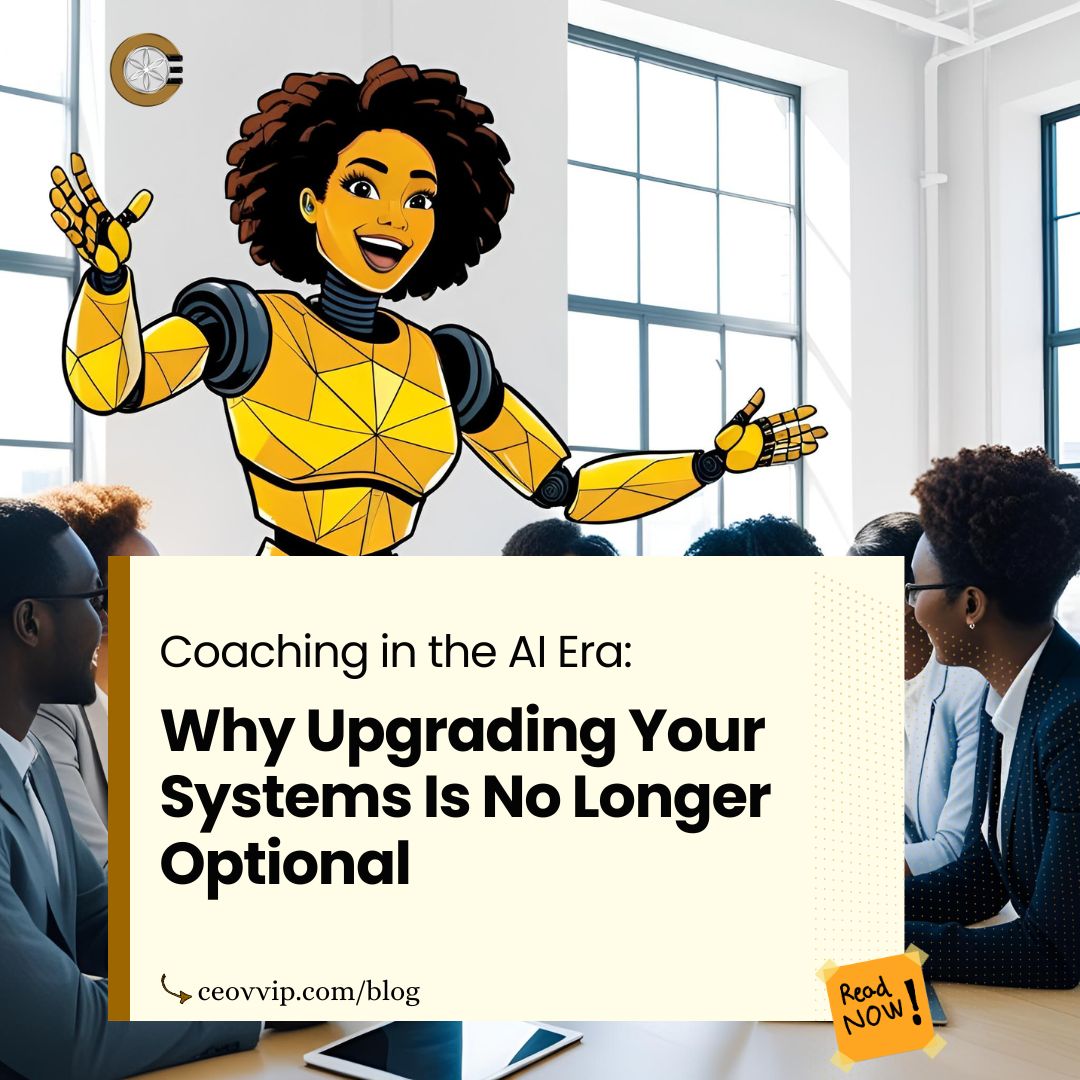
  • Coaching in the AI Era: Why Upgrading Your Systems Is No Longer Optional

    Coaching in the AI Era: Why Upgrading Your Systems Is No Longer Optional

    A few months ago, Coach Amaka sat staring at her laptop, overwhelmed. Booked-out calendar. Endless follow-ups. Clients slipping through the cracks. She was brilliant at what she did—but stuck in a cycle of burnout.

    One night, after missing yet another consultation because her manual scheduling system glitched, she knew something had to change. That’s when she stumbled on an AI assistant tool that could handle client queries, follow-ups, and bookings—all in her brand voice. Skeptical but desperate, she tried it.

    Fast-forward 90 days. Her onboarding now runs on blockchain smart contracts. Payments? Automated. Content delivery? Personalised with AI. And the chatbot? It doesn’t sleep, complain, or forget—just engages, books, and qualifies clients while she rests.

    The result? She doubled her revenue, halved her stress, and now only works with dream clients who’ve already been nurtured before their first call.

    Amaka didn’t become less human. She became more available. More creative. More in control.

    That’s what AI does—it doesn’t erase the coach. It elevates the coach.

    And in a world where authenticity and security are under attack, she’s not just surviving. She’s thriving as an autonomous, AI-enabled sovereign brand.

    Isn’t that the real goal? More impact. Less burnout.

    For decades, the coaching industry thrived on human connection. But today, AI assistants are transforming how coaches operate—streamlining workflows, enhancing client engagement, and driving revenue growth. With deepfakes on the rise and blockchain onboarding becoming inevitable, coaches who fail to integrate AI risk becoming obsolete.

    Watch now: Law of Mentalism- This Ancient Law Unlocks Unlimited Business Success

    Related Posts:

    Entrepreneurs Who Refuse to Automate Are Sabotaging Their Own Success
    Entrepreneurs Who Refuse to Automate Are Sabotaging Their Own Success

    How AI Assistants Are Reshaping Coaching

    AI assistants are no longer just for scheduling meetings or answering FAQs. They are powerful tools that can personalise client experiences, automate marketing, and optimise business operations—giving coaches more time to focus on high-impact interactions.

    The Numbers Speak for Themselves

    • AI coaching can reduce corporate training costs by 50-70% (IBM, 2023).
    •  72% of professionals using AI coaching tools reported improved productivity (McKinsey, 2023)
    • The global AI in education market (which includes coaching) is projected to grow from 30.81 billion by 2032, at a CAGR of 22.7% (Grand View Research, 2023).
    • Companies using AI coaching saw a 25% reduction in employee turnover, according to a study by BetterUp (2023).
    • 61% of employees said AI coaching helped them learn faster than traditional training (Deloitte Human Capital Trends, 2023).
    • 48% of executives use AI-based coaching for leadership development (PwC’s 2023 AI Business Survey).

    The Urgent Need for Coaches to Upgrade Their Systems

    AI is not just a tool—it’s becoming a necessary evolution for coaching businesses. The industry is shifting, and those who fail to adapt will struggle to keep up. Here’s why:

    1. The Deepfake Problem: Authenticity Will Be Tested

    We are entering a new era where seeing is no longer believing. Deepfake technology—powered by advanced generative AI—is becoming increasingly sophisticated, making it alarmingly easy to replicate voices, facial expressions, and entire digital personas. This creates a massive trust gap in the online coaching space, where personal connection, credibility, and authenticity are everything.

    Imagine a potential client encountering a fake video of you promoting a service you never offered. Or worse, scammers impersonating you to defraud your audience. This isn’t a futuristic scenario—it’s already happening. As trust becomes a premium currency in the coaching industry, authenticity verification will no longer be optional.

    To future-proof your coaching brand, blockchain-based identity verification and AI-powered cybersecurity will become crucial. These tools can create a tamper-proof digital fingerprint of your content and identity, assuring clients that every interaction and message truly comes from you. Coaches who act now will earn a competitive edge as trust becomes the defining metric for growth.

    2. Blockchain Onboarding Is Imminent

    Blockchain is no longer just a buzzword—it’s rapidly becoming the backbone of secure, transparent, and scalable business operations. In coaching, this means frictionless onboarding using smart contracts, secure payments, and digital identity verification powered by AI.

    Early adopters are already building blockchain-enabled coaching platforms, attracting global investors and high-ticket clients. Platforms that integrate blockchain will soon become the gold standard, offering seamless onboarding experiences while protecting both coach and client data.

    The urgency? The ecosystem is evolving fast. Funding is pouring in, infrastructure is stabilising, and mainstream adoption is around the corner. Coaches who delay may find themselves left behind.

    9 Steps To Create & Launch 
Your Digital Products & Events Like A Pro.
    9 Steps To Create & Launch Your Digital Products & Events Like A Pro.

    3. Autonomous Sovereignty: Becoming an AI-Enabled Coach

    The most powerful positioning for a coach in 2025 and beyond? Becoming an autonomous sovereign entity.

    This means building a coaching business that is self-sustaining, secure, and scalable—without relying on outdated manual systems or unstable platforms. By integrating AI and blockchain, coaches can:

    • Automate client onboarding, contracts, and scheduling
    • Deliver personalised content and progress tracking in real-time
    • Process payments securely using smart, self-executing protocols

    This is not just about efficiency. It’s about ownership. When your business is powered by AI and anchored in blockchain, you reduce reliance on third-party platforms, eliminate bottlenecks, and create a future-proof brand that clients trust.

    It’s time to move from hustle to sovereignty. From reactive to autonomous. And AI is the bridge.

    How Coaches Can Use AI in Their Business

    1. Client Acquisition & Marketing Automation

    AI can help coaches attract and convert more clients through:

    • AI-driven ad targeting (Google AI, Meta AI)

    • Automated email sequences with AI copywriting

    • AI chatbots that pre-qualify leads

    2. AI-Powered Personalisation for Clients

    Imagine an AI assistant that analyses client progress and recommends personalised coaching strategies. AI can:

    • Track client behaviour & predict engagement patterns

    • Customise coaching content based on client data

    • Automate check-ins & progress reports

    3. Smart Scheduling & Time Optimisation

    AI-powered scheduling tools can:

    • Automatically adjust based on client preferences

    • Sync across multiple time zones

    • Prevent overbooking & optimise availability

    4. AI for Content Creation & Thought Leadership

    Coaches can use AI to generate:

    • SEO-optimised blog posts (like this one)

    • Engaging social media content

    • AI-generated courses & digital products

    5. Financial & Business Automation

    AI can manage:

    • Invoicing & payments

    • Subscription-based coaching models

    • Financial forecasting & revenue tracking

    Monetize your audience
    The best app to start your newsletter

    The Future of Coaching Is AI-Integrated

    Let’s be clear—AI isn’t here to replace coaches. It’s here to enhance, amplify, and expand your impact in ways that were previously unimaginable. The future of coaching isn’t robotic or impersonal—it’s deeply human, powered by intelligent systems that support your brilliance and free up your energy for what matters most: transforming lives.

    The coaches who will lead this new era are not the busiest—they’re the most strategically integrated. They understand that the only way to grow without burning out is to work with AI, not against it.

    When AI is embedded into your systems, you’re no longer limited by time, geography, or human bandwidth. You become scalable, agile, and future-proof. Your business begins to flow—not force. And your clients? They feel the difference.

    Here are four action steps to help you shift:

    1. Adopt AI-Driven Client Engagement Tools – From intelligent chatbots to behavioural analytics, use AI to understand your clients better and create deeper, more meaningful interactions.
    2. Explore Blockchain Onboarding Solutions – Automate contracts, identity verification, and data protection with tamper-proof blockchain technology.
    3. Use AI for Marketing, Personalisation & Automation – Let AI help you craft compelling content, personalise your offers, and nurture leads while you sleep.
    4. Invest in AI Learning & Adaptation – Stay curious. Take short courses, experiment with tools, and build your AI intuition. This is your edge.

    Conclusion: Adapt Now or Get Left Behind

    This is not a trend—it’s a turning point. Coaches who fail to integrate AI will soon be outpaced by those who do.

    As deepfakes rise and blockchain becomes the default for secure digital interaction, AI integration is no longer a competitive advantage—it’s survival.

    The future belongs to autonomous, AI-powered coaches. The only question is: Will you lead it or watch from the sidelines?


    At CEOVIP, get your ideas seen and heard by the people who need them. 

    We automate your content so you can focus on closing deals, creating, and scaling your impact—without the tech headaches. 

    We handle the backend so you have more time to grow your business, make money, and enjoy your freedom.

    Time is money. Stop wasting it on tech struggles. 

    Call now.

    Bossmoney Formula: The Ultimate Launch Blueprint For Your Ebook, Masterclass, Online Course & Virtual Events
    Bossmoney Formula: The Ultimate Launch Blueprint For Your Ebook, Masterclass, Online Course & Virtual Events

  • The ‘One Day’ Lie: Why Waiting to Launch Is Keeping You Stuck

    The ‘One Day’ Lie: Why Waiting to Launch Is Keeping You Stuck

    It’s easy to say, “One day, I’ll launch my business.”
    Or “When I have more money, time, or confidence, I’ll finally start.”

    But here’s the brutal truth: ‘One day’ is a lie that keeps you stuck in the exact same place—while others, with fewer resources and more challenges, move forward and win.

    The Psychological Trap of ‘One Day’ Thinking

    Your brain is wired for survival, not success. It craves certainty and comfort, which is why the idea of launching ‘one day’ feels safer than taking action today. But this is nothing more than a mental trick—a cognitive distortion that keeps you trapped in analysis paralysis.

    Studies in behavioural psychology show that waiting for ideal conditions is a form of procrastination masked as preparation.  According to a 2021 survey by Global Entrepreneurship Monitor (GEM), 48% of adults globally reported that fear of failure would prevent them from starting a business. However, the same report found that entrepreneurs who took the leap despite their fears were more likely to achieve success, with early-stage entrepreneurial activity being a strong predictor of long-term business survival and growth.

    Watch now: Law of Mentalism- This Ancient Law Unlocks Unlimited Business Success

    Related Posts:

    Entrepreneurs Who Refuse to Automate Are Sabotaging Their Own Success
    Entrepreneurs Who Refuse to Automate Are Sabotaging Their Own Success

    The Real Cost of Waiting

    Every day you wait, you’re not just delaying success—you’re actively losing opportunities.

    • Lost Income: If your business could generate just ₦500,000 per month, every month you wait is ₦500,000 gone forever. That’s ₦6 million a year in missed revenue.
    • Lost Market Position: While you hesitate, competitors are building their audience, securing clients, and strengthening their brand authority.
    • Lost Confidence: Action builds confidence, not the other way around. The longer you wait, the more your self-doubt grows, making it harder to start at all.

    Case Study: The Entrepreneur Who Stopped Waiting

    Take Tunde, a Lagos-based consultant who spent three years telling himself he’d launch ‘one day.’ When he finally did, he realised that he could have started much earlier—because most of what he was waiting for didn’t actually matter.

    Within six months, he built a six-figure business. The only thing holding him back was his own mindset.

    The Hidden Opportunity Cost of Delaying Action

    Most people underestimate the compounding effect of lost time. Every day you delay is not just a day wasted—it’s a multiplier of lost potential.

    Let’s break it down:

    • If you start today and generate just ₦10,000 in your first week, that’s ₦40,000 in a month.
    • If you keep improving, scaling, and reinvesting, in six months, that could grow to ₦500,000 per month.
    • Now imagine you waited six months before starting—that’s ₦3 million lost potential revenue, gone before you even begin.

    The longer you wait, the more that lost potential accumulates.

    Why Action Always Beats Perfection

    Jeff Bezos didn’t wait for perfect conditions to launch Amazon. Neither did Aliko Dangote when he started trading cement. Every major business started with imperfect action.

    Additionally, the study highlighted that 70% of startups that succeeded within their first three years had launched an initial version of their product within six months of ideation, even if it was incomplete. These companies used rapid iteration to improve, while those that delayed their launch struggled to gain traction..

    The Fear That Keeps You Stuck

    Most people don’t realise that the real reason they delay isn’t a lack of time, money, or skills—it’s fear of failure and judgment.

    • “What if I fail?”
    • “What if people laugh at me?”
    • “What if I’m not good enough?”

    These thoughts are not facts. They are mental roadblocks designed to keep you in your comfort zone. But comfort zones don’t create success—taking calculated risks does.

    9 Steps To Create & Launch 
Your Digital Products & Events Like A Pro.
    9 Steps To Create & Launch Your Digital Products & Events Like A Pro.

    The Science of Fear and Success

    A 2021 study published in the Journal of Business Venturing —a leading academic journal—found that entrepreneurs who adopt a “growth mindset” and view failure as a learning opportunity are significantly more likely to persist and succeed compared to those who see failure as a reflection of their abilities or readiness.

    The study surveyed over 500 entrepreneurs across Africa and found that those who reframed failure as feedback were 70% more likely to persevere through challenges and ultimately achieve business success. The researchers emphasized that this mindset shift helped entrepreneurs treat setbacks as valuable lessons, enabling them to refine their strategies and improve decision-making.

    Monetize your audience
    The best app to start your newsletter

    Breaking Free from the ‘One Day’ Lie

    1. Start with What You Have

    You don’t need a perfect website, a massive budget, or years of experience. You just need one offer and one client. Build from there.

    2. Set a 30-Day Launch Deadline

    No more waiting. Pick a date in the next 30 days and commit to launching, no matter what. Publicly announce it for accountability.

    3. Shift from Learning to Doing

    Many people hide behind learning as an excuse not to act. Instead of consuming endless courses, apply what you already know and refine it as you go.

    4. Embrace Failure as Data

    Fear of failure is fear of feedback. Every mistake brings insights that improve your next move. Fail fast, learn fast, win faster.

    5. Surround Yourself with Action-Takers

    Your environment shapes your results. If you’re around people who always talk but never act, you’ll stay stuck. Join communities of entrepreneurs who are executing and winning.

    Conclusion: Success Belongs to Those Who Move

    The difference between those who succeed and those who don’t isn’t intelligence, money, or luck—it’s speed of implementation.

    If you’ve been waiting for the right time, this is your wake-up call: ‘One day’ is today.

    Stop waiting. Start building. Your future self will thank you.


    At CEOVIP, get your ideas seen and heard by the people who need them. 

    We automate your content so you can focus on closing deals, creating, and scaling your impact—without the tech headaches. 

    We handle the backend so you have more time to grow your business, make money, and enjoy your freedom.

    Time is money. Stop wasting it on tech struggles. 

    Call now.

    Bossmoney Formula: The Ultimate Launch Blueprint For Your Ebook, Masterclass, Online Course & Virtual Events
    Bossmoney Formula: The Ultimate Launch Blueprint For Your Ebook, Masterclass, Online Course & Virtual Events

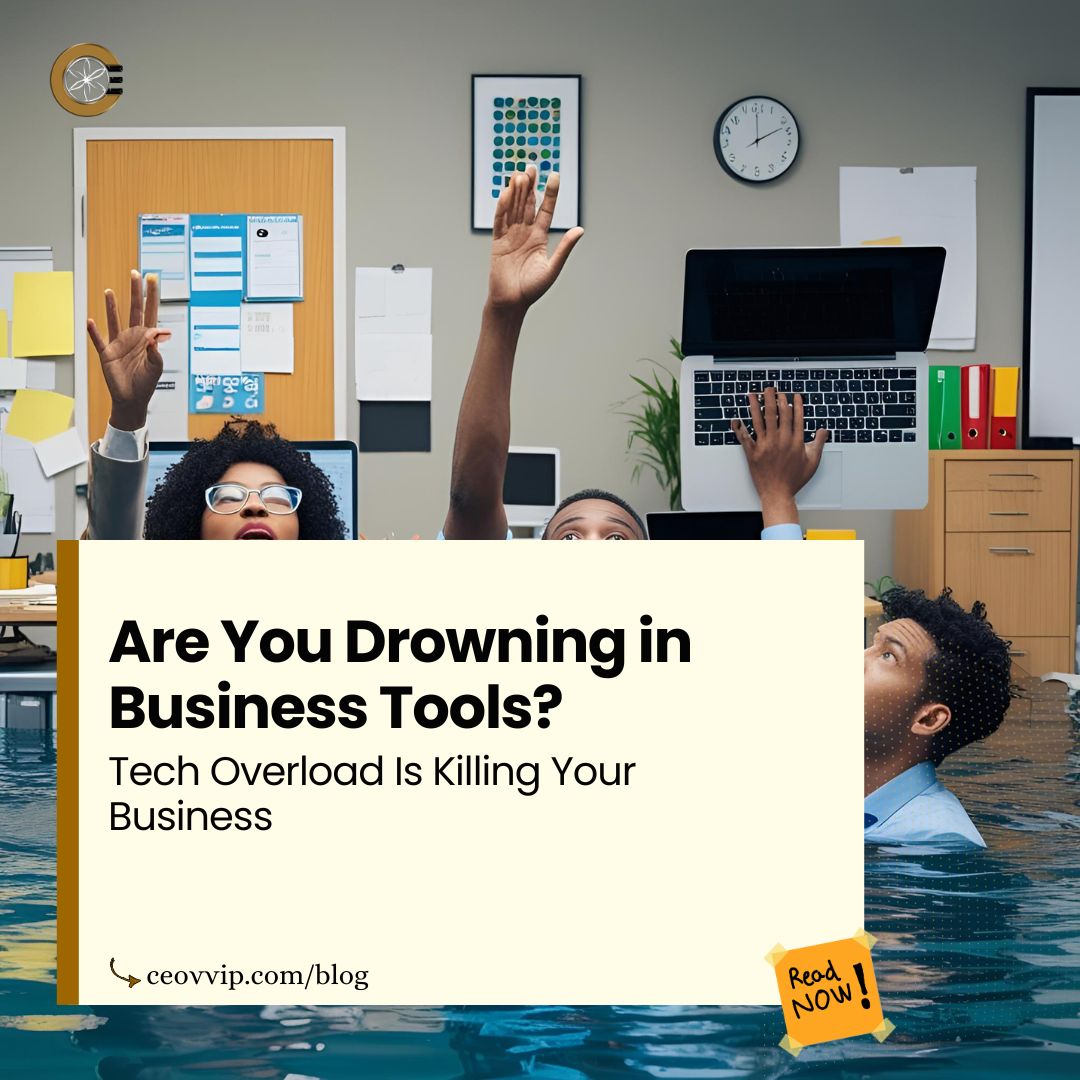
  • Are You Drowning in Business Tools? Tech Overload Is Killing Your Business

    Are You Drowning in Business Tools? Tech Overload Is Killing Your Business

    You’ve been sold a dream—one where every shiny new tool promises to make your business run smoother, faster, better. But here’s the brutal reality: the very tech stack you thought would give you freedom is quietly suffocating your business.

    Think about it. How many times have you spent hours setting up a new tool, only to find yourself tangled in integrations, automations, and endless learning curves? It feels like progress, but is it really?

    In Nigeria’s fast-moving service industry, where agility is everything, business owners are unknowingly falling into a dangerous trap—mistaking complexity for efficiency. The more tools you stack, the harder it becomes to actually get things done. You’re not running your business; you’re managing software.

    This isn’t just an inconvenience—it’s a silent productivity drain. Decision fatigue, mental clutter, wasted budgets… the cost is higher than you think. And while you’re busy troubleshooting your systems, your competitors—the ones who’ve mastered strategic simplicity—are closing deals, delighting clients, and scaling with ease.

    It’s time for a shift. What if the secret to real productivity wasn’t about adding more, but stripping away the excess? What if less could actually make you more? Keep reading—you’ll never look at your tech stack the same way again.

    Watch now: 3 Reasons You’re Not Achieving Your Goals

    Related Posts:

    Win big with automation
    Read now

    Simplify to Amplify

    There’s a silent killer lurking in your business, and it’s disguised as productivity. Every day, service industry professionals—coaches, consultants, agencies—load up on the latest tech tools, believing they’re buying efficiency. But instead of streamlining operations, they’re drowning in dashboards, notifications, and integrations that never quite integrate.

    You started with a simple CRM, then added an email marketing platform, a project management app, a scheduling tool, an analytics dashboard, a course hosting platform… and suddenly, running your business feels like managing an IT department.

    Sound familiar? You’re not alone.

    The Hidden Costs of Tool Overload

    In Nigeria alone, over 78% of small and medium businesses rely on at least five digital tools to manage their operations (Source: PwC Nigeria). Yet, a staggering 64% admit they don’t fully utilise them (Source: Techpoint Africa). That’s a lot of wasted money, time, and energy—resources that should be fueling growth, not creating chaos.

    Here’s the harsh truth: Every tool you introduce creates friction- more logins, more updates, more potential for things to break. Instead of amplifying your productivity, excessive tech stacks create decision fatigue—a well-documented psychological phenomenon where too many choices lead to paralysis.

    Your business doesn’t need more tools. It needs better decisions.

    Negative Cognitive Dissonance: What If Less Is More?

    If you’ve been told that success comes from having the right tools, let’s challenge that belief. What if the very thing you think is helping you is actually holding you back?

    Consider this: some of the most profitable businesses in Nigeria are built on simplified systems. The biggest logistics companies don’t have 20 apps tracking deliveries. The most successful real estate agencies aren’t switching CRMs every quarter. They focus on core processes and optimise them.

    Simplicity isn’t about doing less. It’s about focusing on what actually moves the needle.

    How Too Many Tools Are Hurting Your Bottom Line

    The impact of tech overload isn’t just about inefficiency—it’s about profitability.

    1. Wasted Money – A typical business spends an average of ₦300,000–₦1,500,000 annually on software subscriptions (Source: Statista). But if you’re not fully using them, that’s money down the drain.
    2. Distraction Overload – Studies show that the average person switches between apps up to 1,100 times per day (Source: RescueTime). Each switch costs precious minutes, fracturing focus and killing deep work.
    3. Decreased Productivity – A report by Deloitte revealed that 62% of business owners feel less in control of their operations due to complex tech stacks.

    Your business should feel lighter, not heavier. The more mental load you carry managing tools, the less energy you have to focus on sales, strategy, and growth.

    The 3-Step Simplification Formula: Cut, Consolidate, Control

    If you want to reclaim your business and stop drowning in tools, here’s the approach that actually works:

    Step 1: Cut the Dead Weight

    Not all tools deserve a place in your business. Run a quick audit:

    • What tools have you not used in the last 30 days?
    • Which ones duplicate the same function?
    • Are there free or cheaper alternatives that offer the same value?

    For instance, if you’re paying for both Mailchimp and ConvertKit, do you really need both? If Trello and Asana are running side by side, which one truly serves your workflow best?

    Every tool you eliminate frees up time and money—two things your business desperately needs to scale.

    Step 2: Consolidate the Essentials

    Some tools may be necessary, but they shouldn’t be scattered across 10 different platforms.

    • Use an all-in-one system where possible. Platforms like Zoho, Beehiive, and even WhatsApp Business can centralise multiple business functions.
    • Leverage automation. If you’re manually updating spreadsheets when a CRM could handle it, you’re working against yourself.
    • Standardise your workflow. Instead of switching between Google Drive, Dropbox, and OneDrive, pick one and stick to it.

    The goal is integration, not fragmentation.

    9 Steps To Create & Launch 
Your Digital Products & Events Like A Pro.
    9 Steps To Create & Launch Your Digital Products & Events Like A Pro.

    Real-World Case Study: How a Lagos-Based Coach Boosted Revenue by 40% by Cutting Tools

    Meet Aisha, a business coach in Lagos. She was running her coaching business with 12 different tools—from lead generation to payment processing to client management.

    The problem? She spent more time managing software than coaching clients. Leads slipped through the cracks, follow-ups were inconsistent, and she often felt overwhelmed.

    After an audit, she cut her tool stack down to 5 core platforms. She switched to a single CRM, streamlined client communication through WhatsApp Business, and automated her email marketing.

    The result?

    • 40% revenue increase in three months
    • 3X more client conversions due to faster response times
    • 50% reduction in operational expenses

    Her biggest lesson? Less complexity = more profitability.

    Read More: What’s Holding You Back? Overcoming Common Business Challenges

    Monetize your audience
    The best app to start your newsletter

    The Mindset Shift: Are You Addicted to Complexity?

    Here’s where it gets deep: many business owners subconsciously believe that complexity equals legitimacy.

    • If you’re using 15 different tools, it must mean you’re “running a real business,” right?
    • If your system is simple, are you even doing enough?

    This is a psychological trap. Simplicity doesn’t mean small. It means smart.

    The best businesses don’t run on the most tools—they run on the best decisions.

    Your Next Move: A Challenge for You

    Now that you see how excess tools might be stunting your business growth, here’s what to do next:

    ✅ Make a list of your current software subscriptions.
    ✅ Identify at least two you can eliminate this week.
    ✅ Replace complexity with better systems, not more tools.

    If you truly want to scale, start subtracting, not adding. The leaner your business, the faster it moves.

    And in today’s fast-paced world, speed wins.

    Final Thought: Stop Managing. Start Growing.

    Tech should be a tool, not a trap. The service professionals who win aren’t the ones with the most software—they’re the ones with the sharpest focus.

    So, the question is: will you keep drowning in tools, or will you take control?

    The choice is yours.


    At CEOVIP, get your ideas seen and heard by the people who need them. 

    We automate your content so you can focus on closing deals, creating, and scaling your impact—without the tech headaches. 

    We handle the backend so you have more time to grow your business, make money, and enjoy your freedom.

    Time is money. Stop wasting it on tech struggles. 

    Call now.

    Bossmoney Formula: The Ultimate Launch Blueprint For Your Ebook, Masterclass, Online Course & Virtual Events
    Bossmoney Formula: The Ultimate Launch Blueprint For Your Ebook, Masterclass, Online Course & Virtual Events