Category: Workflow Automation

  • I Read This Book 5 Times. Here’s What Changed.

    I Read This Book 5 Times. Here’s What Changed.

    I’ve Read This Book Five Times. It Still Changes Things.

    There are books you read once and feel good about. There are books you return to because something in you knows you missed something the first time. And then there are books that reorganise the way you see yourself in relation to your work, not loudly, not all at once, but quietly and permanently.

    Og Mandino’s The Greatest Salesman in the World is the third kind.

    I have read it five times. Each reading gave me something different, a new idea, a new angle, a sharper sense of responsibility. Not because the text changed, but because I did. What you are able to receive from a piece of wisdom is always a direct reflection of where you are when you encounter it.

    I want to share what this book has given me as a businessperson. Not as a summary, but as a set of principles I now work with. If you are a coach, consultant, creator, or entrepreneur who has ever felt the friction between knowing what to do and actually doing it with any consistency, this may be your sign to slow down and read this carefully.

    The First Lesson: You Are Not Replicable

    One of the earliest things Mandino establishes is the radical uniqueness of every human being. Since the beginning of recorded time, there has never been another person who sees exactly what you see, thinks exactly as you think, or carries precisely the combination of experience and perspective that you carry.

    This is not flattery. It is a commercial argument.

    The entrepreneur who truly internalises this stops trying to replicate what someone else built and starts building from what only they can offer. For Nigerian and West African business owners, especially people who carry enormous cultural intelligence, lived market knowledge, and community depth, this matters enormously. Your specificity is not a limitation. It is your positioning.

    The business that tries to be like everyone else will always compete on price. The business built from genuine personal distinction creates its own category.

    The Second Lesson: Persistence Is a Decision Made Before the Day Begins

    Mandino’s scrolls return again and again to the theme of persistence, not as a motivational concept but as a practical operating principle. The decision to persist must be made in advance, not in the moment when things become difficult.

    This is something most business advice completely misses.

    We talk about resilience after the fact. We say things like “keep going” when someone is already exhausted. What Mandino understood is that you must build the commitment to continue before you encounter the friction. This is why daily ritual, daily affirmation, and daily intention setting are not soft habits. They are structural business practices.

    If you are waiting until a difficult client conversation or a quiet sales month to decide how committed you are to your work, you are already behind. The decision must live upstream.

    The Third Lesson: Emotional Mastery Is a Business Skill

    Here is where Mandino becomes genuinely useful in ways modern business content rarely is.

    He writes about the circle of moods, the natural fluctuation of human emotion, and makes the observation that weak people allow their thoughts to control their actions, while those who build lasting things learn to master their emotional state so that the work continues regardless.

    This does not mean suppressing feelings. It means refusing to allow temporary emotional weather to determine whether you show up, create, communicate, or sell.

    For coaches and consultants who run personal brands, this is critical. Your mood is not private. It bleeds into your content, your client relationships, your proposals, and your pricing conversations. The person who shows up inconsistently, full of energy one week, absent the next, is communicating something to their audience even when they think they are saying nothing.

    Emotional mastery is not a spiritual luxury. It is what makes your brand feel reliable.

    The Fourth Lesson: Laughter and Lightness Are Strategic

    Mandino dedicates an entire scroll to laughter, to the idea that joy lengthens life, softens difficulty, and restores proportion. He writes that with laughter, all things return to their proper size.

    This is worth sitting with in a business context.

    The entrepreneur who takes every setback with devastating seriousness burns out. The one who can hold failure lightly enough to laugh at it, learn from it, and move through it without drama, that person compounds. They try more. They recover faster. They stay in the game long enough for momentum to build.

    There is a particular kind of Nigerian entrepreneur energy that carries this naturally, the ability to turn a difficult situation into a story, to find the absurdity in a frustrating client, to laugh at the chaos of building something real. That energy is not unprofessional. It is actually what sustains long careers.

    The Fifth Lesson: Dreams Without Execution Are Decoration

    The most commercially sharp line in the entire book, across all my readings, is this: dreams are worthless, and plans are of no value unless they are followed by action. Mandino is not romantic about this. Action is not just the final step,  it is the thing itself. It is the food and drink that nourish success.

    Every coach who has never launched their programme. Every consultant who has been refining their offer for two years. Every creator who has been “getting ready” since last December. This is who Mandino is writing to.

    The conditions will never be perfect. The timing will never be ideal. The fear does not disappear before you begin; it disappears because you begin. Acting without hesitation is not recklessness. It is the only way through.

    What These Five Readings Have Done for My Business

    Each time I return to this book, I find myself more willing to claim my own irreplaceable value, more committed to building systems that hold even when my emotional weather is poor, more comfortable with the pace of real growth, and less patient with the kind of preparation that is actually just delay dressed neatly.

    The greatest salespeople, the greatest consultants, the greatest coaches are not the most polished or the most followed. They are the ones who decided, before the difficulty arrived, that they would persist. That they would act. That they would build something that outlasts a bad month.

    That decision is available to you right now.

    If you are ready to stop preparing and start executing, the 7-Day Launch Challenge will give you the structure to turn what you already know into a live offer in seven days.

    👉 Start The 7-Day Launch Challenge – How to Use AI To Launch Your Ebook, Masterclass or Course in 7 Days https://ceovip.eo.page/7daylaunchchallenge

    CEOVIP
    Learn how to use AI to launch your Ebook, Masterclass or Course in 7 Days: Start The 7-Day Launch Challenge

    👉 Start The 7-Day Launch Challenge — How to Use AI To Launch Your Ebook, Masterclass or Course in 7 Days.
    https://ceovip.eo.page/7daylaunchchallenge

    Watch now: Law of Attraction- How the Law of Vibration Changes Everything

    Related Posts:

    CEOVIP
    Turn Small Audiences into Big Coaching Revenue
    Read Now: The ‘One Day’ Lie: Why Waiting to Launch Is Keeping You Stuck
    9 Steps To Create & Launch 
Your Digital Products & Events Like A Pro.
    9 Steps To Create & Launch Your Digital Products & Events Like A Pro.

    Monetize your audience
    The best app to start your newsletter

    AI Master Prompts - Master ChatGPT Prompts That Help You Create Content That Sells, Even if You’re A Beginner
    AI Master Prompts – Master ChatGPT Prompts That Help You Create Content That Sells, Even if You’re A Beginner

    Still Feeling Stuck? Let’s Talk About It

    Sometimes, it’s not your idea. It’s your system.

    Let me help you see what’s missing and unlock what’s working.

    Book a call with me. We’ll go through your content and systems together.

    Because you didn’t start this business to feel burnt out.
    You started it to be in demand.
    To be paid well.
    To be known.

    It’s time your business reflects that.

    Call now.

    Bossmoney Formula: The Ultimate Launch Blueprint For Your Ebook, Masterclass, Online Course & Virtual Events
    Bossmoney Formula: The Ultimate Launch Blueprint For Your Ebook, Masterclass, Online Course & Virtual Events

  • Your Systems Are Worth More Than Your Social Media

    Your Systems Are Worth More Than Your Social Media

    The Difference Between Looking Successful and Actually Being Successful

    There is a particular kind of business activity that feels productive while costing you everything.

    You know the version. A beautifully designed event announcement. A guest speaker lineup. A polished social media post with strong engagement. Everything looks like growth, but when a new client pays and enters the experience, they find something that does not match what was promised. The packaging oversold the product. The delivery fell short. And that person leaves not just disappointed but vocal about it.

    This is the gap between optics and operations, and for many skilled entrepreneurs, coaches, and consultants,  particularly in Nigerian and West African markets, where community reputation travels fast, this gap is the thing slowly undermining growth.

    Why the Optics Trap Is So Compelling

    The reason so many business owners fall into it is not dishonesty. It is psychology.

    When you invest effort into how your business looks, the feedback is immediate. An audience responds. Likes accumulate. People comment. That response registers in the brain as validation, as progress, as proof that the work is landing. Systems, by contrast, offer no such reward. Building a reliable intake process, connecting your social platforms to your service delivery, creating a client journey that feels smooth from first inquiry to final result, none of that announces itself with applause. It is invisible until it works.

    Now, here is the commercial reality: the invisible infrastructure is precisely what creates the experiences people talk about.

    What a Broken System Actually Costs You

    When a client has a poor experience, the loss is rarely contained to that one person.

    They arrived through your business, they were given a promise through your marketing, and when that promise was not fulfilled, they left with a story. That story does not stay with them quietly. It moves. 

    In a market where trust is built through proximity and shared experience, one disappointed client talking to five people means your reputation has already reached an audience you have never met, and those people already carry a negative impression before they have ever interacted with you directly.

    This is not a theoretical risk. It is a compounding one. And it does not correct itself through more marketing. It corrects itself through better delivery.

    What a System Actually Is

    The word “system” sometimes sounds like a technical concept reserved for large organisations with entire departments dedicated to operations. But at the level of a growing coaching or consulting business, a system is simply the experience your business creates when someone encounters it as a stranger.

    Consider what that experience involves. A potential client finds you on social media and looks for a way to reach you. How simple is that moment? They click a link in your bio. Does that link take them somewhere that immediately answers their question, or does it create more confusion? They have a conversation with you or your team online, and then decide to visit you in person or join a virtual session. Does that conversation carry over, or does someone ask them to start again from scratch?

    Every one of these moments is a test. Not a test the client is giving you consciously, but one they are experiencing unconsciously. Ease creates trust. Friction creates doubt. And doubt, once established, rarely converts to commitment.

    The Standard You Are Actually Being Held To

    Your clients and prospects are not comparing you to other coaches or consultants in isolation. They are comparing you to every smooth experience they have had with any business they have trusted.

    When they use a platform that knows their history, surfaces the right information, and anticipates their next question, a standard is set. When they encounter your business and have to repeat themselves, cannot find basic information, or receive an experience that does not reflect the professionalism of your marketing, that standard is being failed.

    This is worth sitting with, not as self-criticism, but as clarity. The bar is where it is regardless of your intention. The question is whether your current infrastructure is meeting it.

    Building the Backend Is Not Glamorous. It Is Necessary.

    The backend of your business, the automated responses, the connected platforms, the clear client journey, and the consistent follow-up is not the kind of work you post about. There is no social media content in it. There is no event invite, no high-profile guest, no metric that trends.

    But there is something more valuable than any of that. There is a moment when a potential client encounters your business and thinks, without consciously deciding to think it: this is easy, this is clear, this is trustworthy. That thought becomes a booking. It becomes a referral. It becomes the kind of word-of-mouth that no paid campaign reliably produces.

    When your systems are working, your clients become your marketing. Not because you asked them to, but because the experience they had was genuinely worth sharing.

    The Question Worth Asking

    If you are currently running a coaching programme, a course, an ebook, or a consulting offer, it is worth pausing on a few honest questions. When someone discovers you through social media, what happens next? Is there a clear path from curiosity to clarity? When someone purchases, do they move through a journey that feels considered and connected, or do they encounter friction that makes them wonder whether the decision was right?

    You do not need to rebuild everything at once. But you do need to be honest about the gap between what your marketing promises and what your delivery currently provides. Closing that gap is not a cosmetic exercise. It is the foundation of a business with longevity.

    The goal is not to look like you have it together. The goal is to actually have it together and then let the experience speak on your behalf.

    If you are ready to build the kind of offer infrastructure that converts and retains, the 7-Day Launch Challenge was designed for exactly this stage

    👉 Start The 7-Day Launch Challenge – How to Use AI To Launch Your Ebook, Masterclass or Course in 7 Days https://ceovip.eo.page/7daylaunchchallenge

    CEOVIP
    Learn how to use AI to launch your Ebook, Masterclass or Course in 7 Days: Start The 7-Day Launch Challenge

    👉 Start The 7-Day Launch Challenge — How to Use AI To Launch Your Ebook, Masterclass or Course in 7 Days.
    https://ceovip.eo.page/7daylaunchchallenge

    Watch now: Law of Attraction- How the Law of Vibration Changes Everything

    Related Posts:

    CEOVIP
    Turn Small Audiences into Big Coaching Revenue
    Read Now: The ‘One Day’ Lie: Why Waiting to Launch Is Keeping You Stuck
    9 Steps To Create & Launch 
Your Digital Products & Events Like A Pro.
    9 Steps To Create & Launch Your Digital Products & Events Like A Pro.

    Monetize your audience
    The best app to start your newsletter

    AI Master Prompts - Master ChatGPT Prompts That Help You Create Content That Sells, Even if You’re A Beginner
    AI Master Prompts – Master ChatGPT Prompts That Help You Create Content That Sells, Even if You’re A Beginner

    Still Feeling Stuck? Let’s Talk About It

    Sometimes, it’s not your idea. It’s your system.

    Let me help you see what’s missing and unlock what’s working.

    Book a call with me. We’ll go through your content and systems together.

    Because you didn’t start this business to feel burnt out.
    You started it to be in demand.
    To be paid well.
    To be known.

    It’s time your business reflects that.

    Call now.

    Bossmoney Formula: The Ultimate Launch Blueprint For Your Ebook, Masterclass, Online Course & Virtual Events
    Bossmoney Formula: The Ultimate Launch Blueprint For Your Ebook, Masterclass, Online Course & Virtual Events

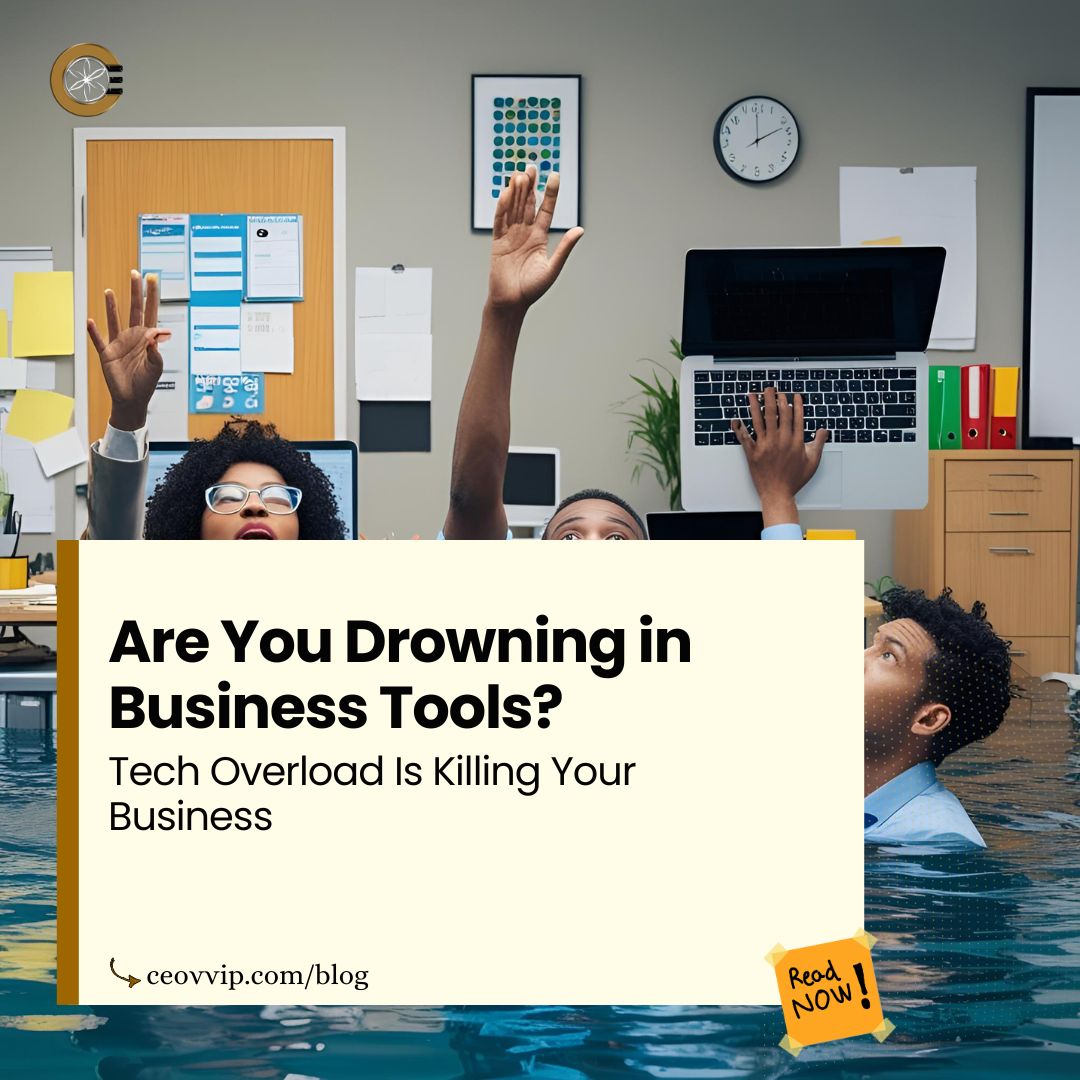
  • Are You Drowning in Business Tools? Tech Overload Is Killing Your Business

    Are You Drowning in Business Tools? Tech Overload Is Killing Your Business

    You’ve been sold a dream—one where every shiny new tool promises to make your business run smoother, faster, better. But here’s the brutal reality: the very tech stack you thought would give you freedom is quietly suffocating your business.

    Think about it. How many times have you spent hours setting up a new tool, only to find yourself tangled in integrations, automations, and endless learning curves? It feels like progress, but is it really?

    In Nigeria’s fast-moving service industry, where agility is everything, business owners are unknowingly falling into a dangerous trap—mistaking complexity for efficiency. The more tools you stack, the harder it becomes to actually get things done. You’re not running your business; you’re managing software.

    This isn’t just an inconvenience—it’s a silent productivity drain. Decision fatigue, mental clutter, wasted budgets… the cost is higher than you think. And while you’re busy troubleshooting your systems, your competitors—the ones who’ve mastered strategic simplicity—are closing deals, delighting clients, and scaling with ease.

    It’s time for a shift. What if the secret to real productivity wasn’t about adding more, but stripping away the excess? What if less could actually make you more? Keep reading—you’ll never look at your tech stack the same way again.

    Watch now: 3 Reasons You’re Not Achieving Your Goals

    Related Posts:

    Win big with automation
    Read now

    Simplify to Amplify

    There’s a silent killer lurking in your business, and it’s disguised as productivity. Every day, service industry professionals—coaches, consultants, agencies—load up on the latest tech tools, believing they’re buying efficiency. But instead of streamlining operations, they’re drowning in dashboards, notifications, and integrations that never quite integrate.

    You started with a simple CRM, then added an email marketing platform, a project management app, a scheduling tool, an analytics dashboard, a course hosting platform… and suddenly, running your business feels like managing an IT department.

    Sound familiar? You’re not alone.

    The Hidden Costs of Tool Overload

    In Nigeria alone, over 78% of small and medium businesses rely on at least five digital tools to manage their operations (Source: PwC Nigeria). Yet, a staggering 64% admit they don’t fully utilise them (Source: Techpoint Africa). That’s a lot of wasted money, time, and energy—resources that should be fueling growth, not creating chaos.

    Here’s the harsh truth: Every tool you introduce creates friction- more logins, more updates, more potential for things to break. Instead of amplifying your productivity, excessive tech stacks create decision fatigue—a well-documented psychological phenomenon where too many choices lead to paralysis.

    Your business doesn’t need more tools. It needs better decisions.

    Negative Cognitive Dissonance: What If Less Is More?

    If you’ve been told that success comes from having the right tools, let’s challenge that belief. What if the very thing you think is helping you is actually holding you back?

    Consider this: some of the most profitable businesses in Nigeria are built on simplified systems. The biggest logistics companies don’t have 20 apps tracking deliveries. The most successful real estate agencies aren’t switching CRMs every quarter. They focus on core processes and optimise them.

    Simplicity isn’t about doing less. It’s about focusing on what actually moves the needle.

    How Too Many Tools Are Hurting Your Bottom Line

    The impact of tech overload isn’t just about inefficiency—it’s about profitability.

    1. Wasted Money – A typical business spends an average of ₦300,000–₦1,500,000 annually on software subscriptions (Source: Statista). But if you’re not fully using them, that’s money down the drain.
    2. Distraction Overload – Studies show that the average person switches between apps up to 1,100 times per day (Source: RescueTime). Each switch costs precious minutes, fracturing focus and killing deep work.
    3. Decreased Productivity – A report by Deloitte revealed that 62% of business owners feel less in control of their operations due to complex tech stacks.

    Your business should feel lighter, not heavier. The more mental load you carry managing tools, the less energy you have to focus on sales, strategy, and growth.

    The 3-Step Simplification Formula: Cut, Consolidate, Control

    If you want to reclaim your business and stop drowning in tools, here’s the approach that actually works:

    Step 1: Cut the Dead Weight

    Not all tools deserve a place in your business. Run a quick audit:

    • What tools have you not used in the last 30 days?
    • Which ones duplicate the same function?
    • Are there free or cheaper alternatives that offer the same value?

    For instance, if you’re paying for both Mailchimp and ConvertKit, do you really need both? If Trello and Asana are running side by side, which one truly serves your workflow best?

    Every tool you eliminate frees up time and money—two things your business desperately needs to scale.

    Step 2: Consolidate the Essentials

    Some tools may be necessary, but they shouldn’t be scattered across 10 different platforms.

    • Use an all-in-one system where possible. Platforms like Zoho, Beehiive, and even WhatsApp Business can centralise multiple business functions.
    • Leverage automation. If you’re manually updating spreadsheets when a CRM could handle it, you’re working against yourself.
    • Standardise your workflow. Instead of switching between Google Drive, Dropbox, and OneDrive, pick one and stick to it.

    The goal is integration, not fragmentation.

    9 Steps To Create & Launch 
Your Digital Products & Events Like A Pro.
    9 Steps To Create & Launch Your Digital Products & Events Like A Pro.

    Real-World Case Study: How a Lagos-Based Coach Boosted Revenue by 40% by Cutting Tools

    Meet Aisha, a business coach in Lagos. She was running her coaching business with 12 different tools—from lead generation to payment processing to client management.

    The problem? She spent more time managing software than coaching clients. Leads slipped through the cracks, follow-ups were inconsistent, and she often felt overwhelmed.

    After an audit, she cut her tool stack down to 5 core platforms. She switched to a single CRM, streamlined client communication through WhatsApp Business, and automated her email marketing.

    The result?

    • 40% revenue increase in three months
    • 3X more client conversions due to faster response times
    • 50% reduction in operational expenses

    Her biggest lesson? Less complexity = more profitability.

    Read More: What’s Holding You Back? Overcoming Common Business Challenges

    Monetize your audience
    The best app to start your newsletter

    The Mindset Shift: Are You Addicted to Complexity?

    Here’s where it gets deep: many business owners subconsciously believe that complexity equals legitimacy.

    • If you’re using 15 different tools, it must mean you’re “running a real business,” right?
    • If your system is simple, are you even doing enough?

    This is a psychological trap. Simplicity doesn’t mean small. It means smart.

    The best businesses don’t run on the most tools—they run on the best decisions.

    Your Next Move: A Challenge for You

    Now that you see how excess tools might be stunting your business growth, here’s what to do next:

    ✅ Make a list of your current software subscriptions.
    ✅ Identify at least two you can eliminate this week.
    ✅ Replace complexity with better systems, not more tools.

    If you truly want to scale, start subtracting, not adding. The leaner your business, the faster it moves.

    And in today’s fast-paced world, speed wins.

    Final Thought: Stop Managing. Start Growing.

    Tech should be a tool, not a trap. The service professionals who win aren’t the ones with the most software—they’re the ones with the sharpest focus.

    So, the question is: will you keep drowning in tools, or will you take control?

    The choice is yours.


    At CEOVIP, get your ideas seen and heard by the people who need them. 

    We automate your content so you can focus on closing deals, creating, and scaling your impact—without the tech headaches. 

    We handle the backend so you have more time to grow your business, make money, and enjoy your freedom.

    Time is money. Stop wasting it on tech struggles. 

    Call now.

    Bossmoney Formula: The Ultimate Launch Blueprint For Your Ebook, Masterclass, Online Course & Virtual Events
    Bossmoney Formula: The Ultimate Launch Blueprint For Your Ebook, Masterclass, Online Course & Virtual Events