Tag: business

  • Why More Visibility Isn’t The Reason You’re Not Selling

    Why More Visibility Isn’t The Reason You’re Not Selling

    I want to tell you something I say to my clients often, and it usually feels somewhere between relief and mild offence.

    You probably don’t have a visibility problem.

    I know that’s not what you were told. Somewhere along the way, someone convinced you that if the numbers aren’t moving, the answer is simply to do more. Post more. Email more. Show up on another platform you don’t even enjoy. If you’re posting twice a day, post seven times. If you’re sending ten emails a week, send fifty. I understand the logic. Scaling activity feels like progress. But before you compound anything, I need you to answer one honest question first.

    What exactly do you want to be visible for?

    ### The Wide Net Doesn’t Catch More, It Catches Confusion

    Here’s where a lot of skilled, credible people get stuck. You have real experience. You’ve helped people before. But when someone asks what you do, the answer comes out broad. Something like, I help entrepreneurs save more time and achieve their goals.

    On paper, that sounds generous. In practice, it tells your ideal client nothing. Which entrepreneurs. Real estate people, salon owners, group business owners, actors, influencers. And which goals. Personal goals, business goals, money goals, habit goals, team building goals. You’ve cast a wide net thinking the wider it is, the more fish you’ll catch.

    The problem is human beings are not fish.

    People have priorities, and those priorities are ranked. A busy mother might genuinely want to learn how to swim one day. But right now, making sure her team has the right tools and her business is stable comes first. That’s not a lack of interest in swimming. That’s a hierarchy of needs, and your offer has to know exactly where it sits in someone’s hierarchy before it can compete for their attention.

    ### Shouting Louder In The Wrong Market

    Think about walking into an electronics shop when what you actually want is a wig. Now imagine you’re the one selling wigs, standing inside that same electronics market, convinced that if you just shout louder, someone will eventually buy. You could have the best wig in Lagos. It won’t matter. You are loud in the wrong room.

    That’s what happens when visibility becomes your strategy without positioning underneath it. You’re not reaching the wrong number of people. You’re reaching the wrong people, loudly.

    ### Why Boundaries Matter More Than You Think

    This is where I want you to sit with the idea of clear boundaries, not as restriction, but as filtering. Boundaries help you filter out the rubbish, the irrelevant, the activity for activity’s sake that doesn’t move your top line or your bottom line. Without them, you end up trying to do everything, for everyone, everywhere.

    And when you scatter your energy across ten directions, nothing gets the depth it needs to actually work. Things move slowly not because you’re lazy, but because your effort is spread too thin to build momentum anywhere.

    More visibility without clear positioning doesn’t bring you better clients. It brings you more of the same friction. More conversations that go nowhere. More I’ll think about it, or it’s too expensive, or let me pray on it, from people who were never your right fit to begin with. Not because your offer lacks value, but because it never spoke to them clearly enough to matter more than their excuses.

    ### The Real Work Is Releasing The Idea That Loud Equals Understood

    Here’s the mind shift I want you to take from this. The people who genuinely need what you offer aren’t sitting there wondering if they need help. They already know that. What they’re actually asking, silently, is this. Do you understand my problem well enough to solve it for me?

    That understanding doesn’t come from volume. It comes from clarity. Until you know exactly who you are, where your value sits, and what your specific strength is, you can’t build that into a product or service that genuinely helps anyone.

    When you try to be everything to everyone, you end up being memorable to no one.

    I know the fear underneath the resistance to narrowing down. It feels like if you get specific, you’ll miss out on the people outside that lane. But you won’t. What is yours is yours, and it responds to being called by name, not shouted at from a distance.

    If you’re still in a season of soul searching, that’s fine. Your results will reflect that, scattered, inconsistent, everywhere at once, because you’re still discovering who you are and how you prefer to work. But the moment you decide, clearly, on who you serve and what you solve, you gain the ability to say it in a way that pulls in the people who are ready, willing, and able to buy from you again and again.

    That’s not a visibility upgrade. That’s a positioning decision.

    And once your positioning is clear, the systems that turn that clarity into consistent income are what we build inside the 7 Day Launch Challenge.
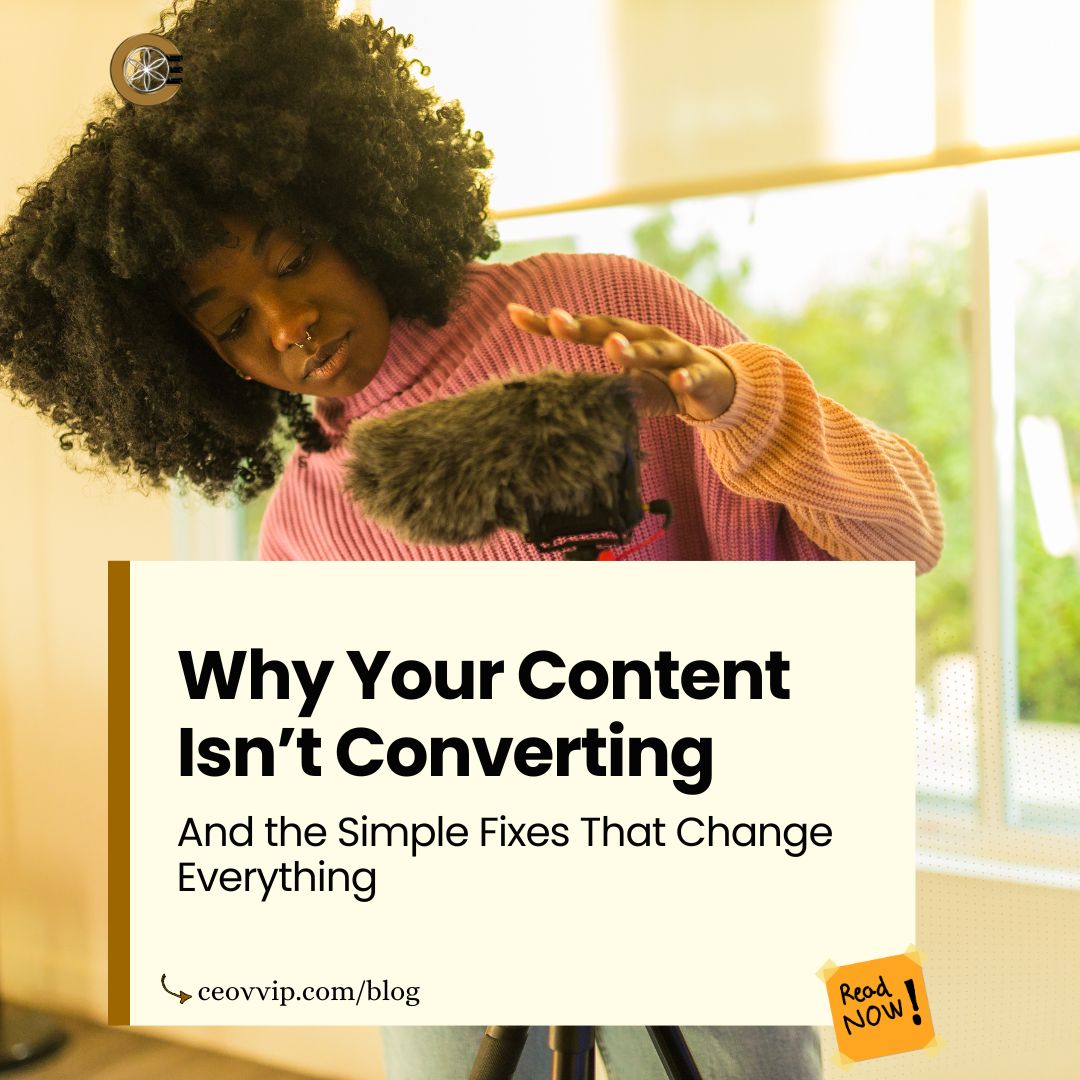

  • Beautiful Content Doesn’t Convert- This Converts

    Beautiful Content Doesn’t Convert- This Converts

    I know someone who had 20,000 followers on Instagram. She created makeup content, all beautifully shot and arranged. Her followers loved her. By all the metrics that matter to vanity, she was winning.

    She was also completely broke.

    This is the gap most creators don’t understand: beautiful content and converting content are not the same thing. And until you recognise the difference, you’ll spend months or years feeding an audience that admires you but doesn’t buy from you.

    The myth most people believe

    There’s a belief that sits behind most content creation: if the content is good enough, if it’s pretty enough, people will eventually convert. So creators optimise for optics. And they get exactly what they optimised for: likes, comments, shares, recognition. Just not money.

    Here’s what’s actually happening. Your audience is giving you feedback on how much they enjoy the experience. They’re not giving you feedback on whether they want to buy from you. These are two completely different conversations.

    Content and sales speak different languages

    Content has a language. Sales has a different language entirely. Content language talks about information, beauty, inspiration, and ideas. It says, “Look at this.” Sales language talks about desire and the shortest path to fulfilling it. It says, “I see what you want, and here’s exactly how to get it.”

    The makeup artist was creating gorgeous content that had zero commercial intention attached to it. Which meant no matter how many people engaged, nobody was buying. The content itself wasn’t the problem. The language was.

    What the language of sales actually sounds like

    Sales speaks to a desire someone has. Something they want. Something they’re missing. Something that keeps them up at night. Then it offers the clearest, most transparent path to getting it.

    For you to translate your content into conversion, you need to start creating content that speaks to a specific problem your client has, a desire they hold, or a fear they’re not saying aloud but thinking about every single day. You mirror that back to them. You make them feel seen. That’s when the language shifts from admiration to action.

    Who you’re speaking to determines everything

    Most creators create “for everyone.” But you can’t speak the language of sales if you’re not clear on who you’re actually talking to. The tighter you get on who you’re speaking to, the sharper your message becomes. And the sharper your message, the higher your conversion. Niche clarity isn’t limiting. It’s focusing.

    Cause and effect in your content strategy

    There’s a law most people ignore: cause and effect. The energy you invest in becoming better at selling, at understanding your client, converts into a different kind of attraction. You attract clients who resonate with the frequency of your message. Not fans. Clients.

    Most people create content about their offer — features, benefits, how good it is. But nobody cares how good your offer is until they see themselves in the problem you’re solving. Your content needs to spend time in their world. Their insecurity. Their desire. Their fear. Before you ever talk about your solution.

    The identity shift that changes everything

    You’re not building content for engagement. You’re building a message that connects someone’s deepest need with your clearest solution. When you shift from “I want people to like my content” to “I want to attract clients who need what I offer,” everything changes. You stop chasing vanity metrics. You start chasing clients. And that’s when money starts moving.

    What to do now

    Look at your last five pieces of content. Ask yourself honestly: Does this speak to a desire someone has? Does it offer the shortest, most transparent path to fulfilling that desire? Does it make someone feel seen?

    If the answer is no, you know what to change. Not the aesthetics. The cause. Change what you’re communicating, and the effect will follow.

    Your 20,000 followers aren’t the goal. Your clients are. Your revenue is. Your impact is. Build content that speaks to that.

    Ready to launch something that actually converts? Start The 7-Day Launch Challenge – How to Use AI To Launch Your Ebook, Masterclass or Course in 7 Days
    https://ceovip.eo.page/7daylaunchchallenge

  • How Smart Businesses Are Winning Big with Automation 

    How Smart Businesses Are Winning Big with Automation 

    In today’s fast-paced business landscape, where every decision can make or break your success, smart businesses are turning to automation to gain a competitive edge. Imagine this: You’re running your business, and everything is moving at lightning speed. Decisions need to be made faster, operations need to run smoother, and the competition is always breathing down your neck. It’s a lot, right? But what if I told you there’s a way to not just keep up but actually win—all by working smarter, not harder? The answer is automation.

    Now, I know, automation can sound a bit technical, but stick with me. It’s not about fancy tech or replacing jobs. It’s about freeing you and your team from the everyday grind so you can focus on growing your business. And the best part? Businesses in your space, right here in West Africa, are already using it to their advantage.

    Content

    1. Why Automation Is a Game-Changer
    2. Real Success Stories: MTN’s Big Win with Automation
    3. Making Smarter Decisions with Automation
    4. Saving You Money—Fast
    5. Enhancing, Not Replacing, Your Team
    6. What Does This Mean for You?

    Related Post: How to Build a Sales Funnel That Converts Strangers To Buyers

    Why Automation Is a Game-Changer

    Let me ask you this: how much time does your team spend on repetitive tasks? Things like responding to customer inquiries, processing payments, or tracking inventory. Probably more than you’d like, right? Now, imagine if those tasks could be handled automatically, freeing up your time to focus on more important things—like building relationships with your clients or growing your revenue. That’s what automation does.

    According to McKinsey, businesses that embrace automation can increase productivity by 20-30%. Think about that for a second. That’s like getting an extra day’s work done every week without adding a single extra hour to your schedule.

    And it’s not just theory—it’s happening right now.

    Real Success Stories: MTN’s Big Win with Automation

    Take MTN, for example. You know MTN, one of the largest telecom companies on the continent. They were dealing with millions of customer service requests every day. It was overwhelming for their team. So, they introduced automated systems to handle the most common queries. What happened next was incredible: customer wait times plummeted, satisfaction shot up, and their team was able to focus on bigger, more complex issues that actually required a human touch.

    The result? A more efficient business, happier customers, and a company that’s thriving. And it’s not just a big company thing—you can do the same in your business, no matter its size.

    Create & Launch Your Digital Product (ebooks, masterclasses, online courses & events) Like A Pro
    Create & Launch Your Digital Product (ebooks, masterclasses, online courses & events) Like A Pro

    Making Smarter Decisions with Automation

    Here’s another thing that often gets overlooked: data. Your business generates tons of it every day. But if you’re like most people, you probably don’t have the time (or energy) to sift through it all. That’s where automation steps in again. It doesn’t just handle tasks; it helps you make smarter, data-driven decisions.

    Imagine this: you’re running an e-commerce store, and you want to send personalized offers to your customers based on their past purchases. Do you have time to go through every order? Probably not. But automation does. It can track your customers’ preferences, analyze buying patterns, and send targeted offers at the perfect time—all while you focus on bigger plans.

    A company like Jumia is doing exactly this, using automation to track buying behavior and personalize their marketing. The result? Higher sales, better customer loyalty, and a business that just keeps growing.

    Saving You Money—Fast

    Let’s talk about money. Automation is not just a fancy tool to save time; it’s a cost-saving machine. In fact, Goldman Sachs estimates that GenAI has the potential to improve productivity growth by 1.5% and raise the global GDP by 7%, the equivalent of $7 trillion, over the next 10 years.

    For example, I know of a financial services company in West Africa that was constantly dealing with delayed payments and errors. It was a mess. After introducing automation to handle their payment processing, they slashed their operational costs by 35% and sped up transactions by 60%. Just think of what that kind of cost saving could mean for you.

    Enhancing, Not Replacing, Your Team

    Now, let’s get one thing straight—automation isn’t about replacing people. It’s about enhancing what your team can do. By automating routine tasks, your staff can focus on what they do best: building relationships, solving problems, and driving growth.

    Take the hospitality industry, for example. Hotels across West Africa are using automation for things like managing bookings, processing payments, and handling routine customer requests. It frees up their teams to focus on what really matters—creating memorable experiences for their guests.

    A great example is Transcorp Hotels in Nigeria. They used automation to streamline their booking system, and guess what? The profit margin increased by 22.2% in the first half of 2024. Imagine what that kind of boost could do for your business.

    So, What Does This Mean for You?

    Here’s the bottom line: automation is no longer just a buzzword or a trend. It’s a tool that smart businesses—like yours—are using to win big. Whether you’re looking to save time, cut costs, make better decisions, or simply offer a better experience for your clients, automation can help you get there.

    It’s not about replacing what you’re already doing. It’s about enhancing it. Just like MTN, Jumia, and Transcorp Hotels have done, you can use automation to work smarter, serve your customers better, and ultimately, grow your business.

    So, here’s my question for you: Are you ready to work smarter? Because the businesses that win are the ones that embrace change and stay ahead of the curve. And automation? That’s your key to staying ahead.

    Ready to leap? Let’s make it happen.

    At CEOVIP, experience bigger and faster results through our AI-powered marketing strategies. Schedule a call today to get your customised digital marketing blueprint.

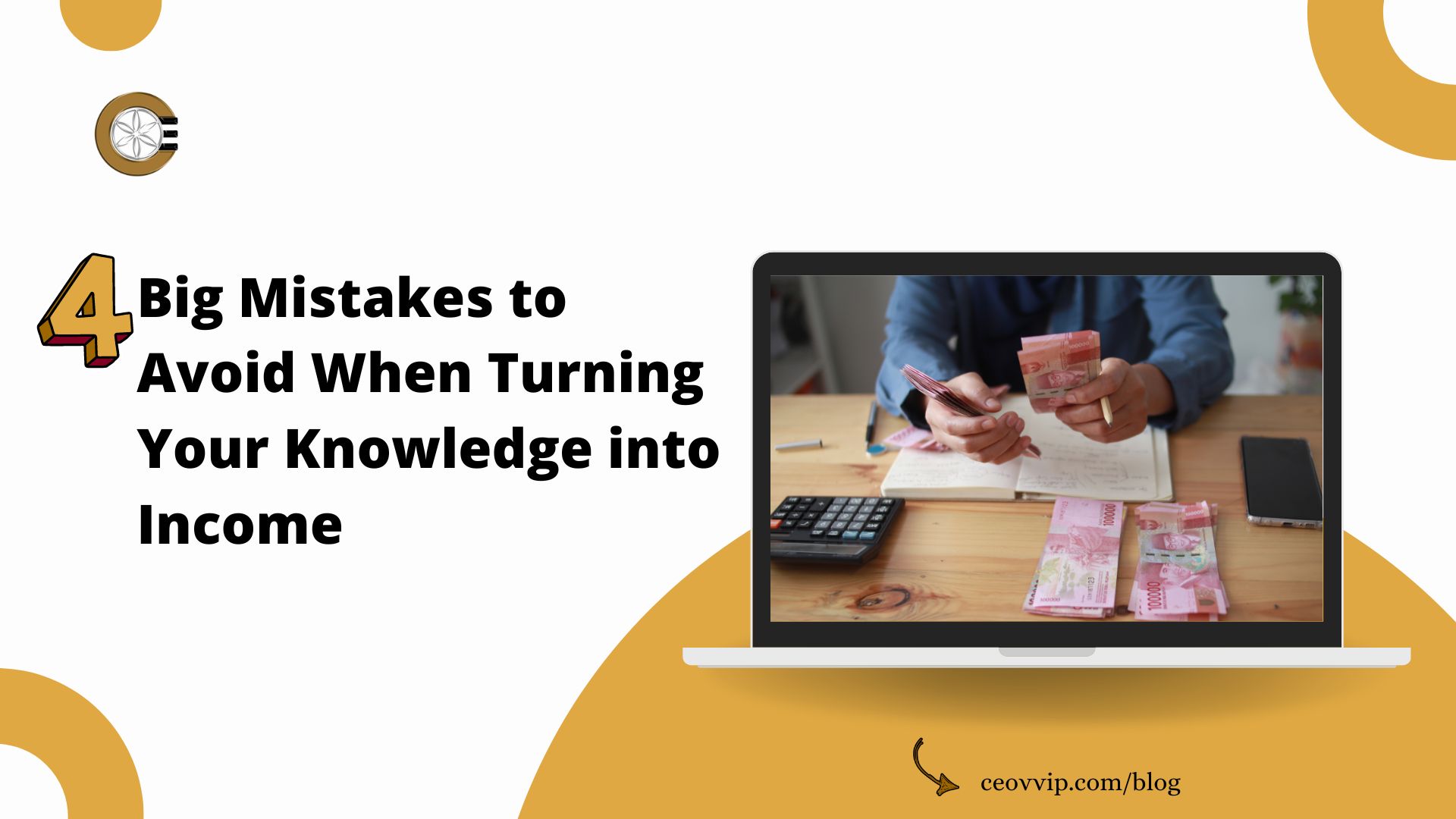
  • 4 Big Mistakes to Avoid When Turning Your Knowledge into Income

    4 Big Mistakes to Avoid When Turning Your Knowledge into Income

    As an entrepreneur working hard to build a business, you’ve probably already realized that monetising your knowledge is not only possible, but it’s also one of the most rewarding paths to financial freedom. Whether you’re exploring coaching, consulting, course creation, or digital products, the potential for growth is endless. 

    In today’s knowledge economy, the value of what you know can be transformed into streams of income that build wealth over time. But there are a few critical mistakes that can trip you up if you’re not careful. 

    When you recognise these 4 mistakes in your business you can avoid them when monetising your expertise.

    1. Failing to Identify Your Ideal Client
    2. Overvaluing Your Expertise
    3. Focusing on Quantity over Quality
    4. Ignoring the Importance of Marketing

    Related Post: 3 Secrets to Creating Irresistible Content for Your Audience

    1. Failing to Identify Your Ideal Client

    Imagine walking into a crowded room, shouting out random facts about your expertise, and hoping someone listens. That’s what happens when you fail to identify your ideal client. You can have the most valuable knowledge, but if you don’t know who you’re serving, your message will fall flat.

    Understanding your ideal client is key to monetising effectively. When you zero in on your target market, you increase your ability to scale faster because you craft your offers around real needs. 

    Think of how Marie Forleo created her B-School for aspiring digital entrepreneurs. She didn’t cater to “everyone.” Instead, she built her program around the needs of ambitious women looking to launch their online businesses. 

    By understanding their pain points—overwhelm, lack of clear strategy, confusion about tech—she created solutions that sold out year after year.

    Your success lies in getting crystal clear about your audience. What are their pain points? What desires keep them up at night? 

    When you know them intimately, your content and offerings will not only resonate but inspire action.

    2. Overvaluing Your Expertise

    Here’s a truth bomb: It’s easy to overestimate what people are willing to pay when you’re new to monetising your knowledge. Of course, you’ve worked hard to develop your expertise, and it’s understandable to feel like your insights are priceless. But, as with any business, there’s a delicate balance between valuing your worth and remaining accessible to your audience.

    When you’re just getting started, consider market research your best friend. Look at what others in your field are charging. 

    For instance, the coaching industry has grown exponentially, with over 71,000 certified coaches globally (according to the International Coaching Federation), many charging premium rates. 

    However, early-stage coaches should begin with competitive pricing to build their client base, establishing credibility before scaling their fees.

    Remember, pricing isn’t just about your expertise; it’s about the perceived value of your product or service. The more targeted and solution-driven your offer is, the easier it will be to price higher over time.

    3. Balancing Quantity and Quality

    There’s a common misconception that you must choose between quality and quantity, but the truth is, they are not mutually exclusive. Especially in the early stages of your entrepreneurial journey, you’re in what I like to call the “baby season” of business, where experimentation and trial and error are essential. You’re still figuring out what works, so the need for quantity is just as important as quality.

    Let’s look at YouTube’s origin story as a perfect example. It started as a dating site but quickly pivoted when the data showed that users were uploading all types of videos, not just dating-related content. That data was only available because they pushed out enough content to see the patterns. Without a substantial amount of content (quantity), they wouldn’t have been able to gather the insights needed to refine the platform (quality).

    The same principle applies to your business. In this testing phase, you’re experimenting with your product, audience, and processes. It’s through the volume of content and engagement that you’ll gather the critical feedback necessary to improve and fine-tune your offerings. Yes, quality is important, but don’t let the fear of “not being perfect” hold you back from producing enough to truly understand your market.

    Think of quantity as your feedback mechanism. The more you put out there, the more data you’ll have to shape your quality later on. It’s about finding that balance—allow yourself to create consistently and improve along the way.

    4. Ignoring the Importance of Marketing

    Let’s face it: If you build it, they won’t necessarily come. You can have the best product, the most engaging content, and life-changing knowledge, but if no one knows about it, it’ll gather digital dust. The #1 mistake entrepreneurs make when monetising their knowledge is underestimating the power of marketing.

    A staggering 70% of businesses fail within the first decade, and poor marketing strategy is often a key culprit. You need to be visible, vocal, and valuable. Think of Gary Vaynerchuk, who leveraged social media to turn his family’s wine business into a multi-million-dollar company. 

    His success didn’t come from just having expertise in wine. It came from consistently marketing that expertise across platforms, engaging with his audience, and sharing insights.

    Don’t be afraid to invest in marketing, whether through social media, paid ads, SEO, or email campaigns. Find what works for you and get in front of your audience consistently. It’s not just about attracting customers; it’s about building relationships that convert over time.

    Real-World Case Study: How Pat Flynn Monetized His Knowledge

    Take the example of Pat Flynn, founder of Smart Passive Income. When Flynn lost his job as an architect during the 2008 recession, he decided to monetize his knowledge of LEED certification through an online course.

    He didn’t start by pushing his content to everyone. Instead, he took time to understand his audience—architects and engineers seeking certification. By offering valuable content tailored specifically to their needs, Flynn built a six-figure business within a year.

    The secret to Flynn’s success? He avoided the common pitfalls—he knew his ideal client, priced his course competitively, focused on quality, and marketed relentlessly.

    Conclusion

    Monetising your knowledge is an exciting and rewarding journey, but it’s also one that requires strategic thinking. By avoiding these four mistakes—failing to identify your ideal client, overvaluing your expertise, focusing on quantity over quality, and ignoring marketing—you’ll set yourself up for sustainable success.

    As you move forward, remember this: Every piece of content you create, every client you serve, and every marketing effort you make should be intentional. Success is about crafting a strategy that works for you and, most importantly, for your audience. Now go out there and start building that profitable, purpose-driven business!

    Bossmoney Formula: The Ultimate Launch Blueprint For Your Ebook, Masterclass, Online Course & Virtual Events.
    Bossmoney Formula: The Ultimate Launch Blueprint For Your Ebook, Masterclass, Online Course & Virtual Events.
  • 4 Mistakes To Avoid When Monetizing Your Knowledge

    4 Mistakes To Avoid When Monetizing Your Knowledge

    If you have knowledge or expertise in a particular field, you may be interested in monetizing that knowledge. Whether it’s through coaching, consulting, writing, speaking, or creating courses, there are a variety of ways to turn your knowledge into income. That is the beauty of this digital age and you’re on the right track if you’re thinking of monetizing.

    However, there are a few common mistakes that many people make when attempting to monetize their knowledge. In this article, we’ll discuss the top 4 mistakes to avoid when monetizing your knowledge.

    • Failing to Identify Your Ideal Client
    • Overvaluing Your Expertise
    • Focusing on Quantity over Quality
    • Ignoring the Importance of Marketing

    Watch Now: How to get leads from social media

    1. Failing to Identify Your Ideal Client

    A major key to monetizing your knowledge is to identify your ideal client. Who are the people that will benefit most from what you have to offer? What are their pain points, goals, and desires? It’s important to understand your audience so that you can match your content and offerings to their specific needs. Without a clear understanding of your ideal client, you risk creating content that doesn’t resonate or fails to reach your target market altogether.

    2. Overvaluing Your Expertise

    While it’s important to recognize the value of your knowledge, it’s also essential to avoid overvaluing it. It can be tempting to charge exorbitant prices for your services or products, but if your prices are too high, you may price yourself out of the market, especially when you’re new in the space. Research your competitors and determine what similar services or products are being offered and at what price point. This will help you to determine a fair price for your offerings. As your brand becomes more popular, you can increase your price.

    3. Focusing on Quantity over Quality

    When you’re just starting out, it can be tempting to create as much content as possible in order to build your audience quickly. However, focusing on quantity over quality can actually harm your efforts in the long run. Creating high-quality content that is tailored to your audience’s needs will help to establish your credibility and build trust with your audience. Take the time to create valuable content that your audience will find helpful and engaging, and you’ll be more likely to attract and retain loyal followers.

    4. Ignoring the Importance of Marketing

    Finally, many people make the mistake of assuming that if they build it, people will come. However, without a solid marketing strategy, you may struggle to attract and retain customers. You need to be visible and present on social media, advertise your products and services, and actively engage with your audience. Marketing can take many forms, so be sure to research and experiment with different methods to find what works best for your business.

    In conclusion, monetizing your knowledge can be a rewarding and fulfilling way to earn an income. However, to avoid common mistakes, be sure to identify your ideal client, set fair prices, focus on quality content, and develop a solid marketing strategy. With a little patience and perseverance, you can turn your knowledge into a profitable business. Good luck!