When I launched the 7-Day Launch Challenge, I saw two types of people sign up. Both were coaches, consultants, or professionals with valuable ideas. Both wanted to create a digital product and start earning online. Both had the same opportunity.
But one group took action immediately. The other group hesitated or walked away entirely.
The difference? Money thoughts.
Your money thoughts shape how you see opportunities, how quickly you act, and whether you create wealth or stay stuck. Here are 7 hidden money patterns that kill sales.
Quick List of Money Patterns
Money as a Wall vs. Money as a Tool
The Poverty Trap of “I Can’t Afford It”
Money Thoughts Shape Execution Speed
Resourcefulness Pays More Than Resources
Wealth Thinkers Calculate ROI Differently
Confidence Over Credentials in Selling
Shifting from “I Can’t” to “How Can I?”
1. Money as a Wall vs. Money as a Tool
When faced with the ₦7,000 registration fee, one group asked: 💬 “How can I make this happen?” The other group said: 💬 “I can’t afford it right now.”
The first question unlocks creativity. The second shuts it down. The truth is, the rich mindset is not about having millions in your bank account. It’s about seeing money as a tool to get you closer to your goals. The poor mindset sees money as a wall that blocks them from trying.
2. The Poverty Trap of “I Can’t Afford It”
“I can’t afford it” feels safe. It means you don’t have to risk failure, embarrassment, or the discomfort of trying something new.
But it also means you stay stuck. It means you never develop the skill of resourcefulness. And in business, resourcefulness pays more than resources.
3. Money Thoughts Shape Execution Speed
Your money thoughts determine:
How you approach opportunities — Do you seek a way forward or list reasons you can’t move?
Your speed of execution — Do you act fast or wait until the moment is gone?
Your capacity for risk — Are you willing to trade short-term comfort for long-term gain?
The longer you stay in hesitation, the more momentum you lose.
4. Resourcefulness Pays More Than Resources
Every great business was started by someone who didn’t “have enough.” What they had was resourcefulness.
Instead of waiting until conditions were perfect, they leveraged creativity, relationships, and urgency. The same applies to your sales. When you position your offer as something that helps buyers overcome their limits, you attract action-takers.
5. Wealth Thinkers Calculate ROI Differently
Wealthy thinkers approach investments differently. They ask:
How will this pay for itself?
What’s the ROI on my time, not just my money?
Who can I partner with, sell to, or learn from to offset this cost?
This shift from “I can’t” to “How can I?” is the first step toward financial independence. It’s the same shift your clients need to make before they buy from you.
6. Confidence Over Credentials in Selling
When selling your digital product, people don’t trust the smartest person. They trust the most certain one.
If you show doubt in your price, process, or results, prospects will sense it and pull back. Confidence is contagious. When you embody certainty in the value of your work, your sales will reflect it.
7. Shifting from “I Can’t” to “How Can I?”
The next time you’re faced with an opportunity, pause. Notice your default money thought.
Then ask yourself: 💬 “If I really wanted this, how could I make it happen?”
That one shift will reshape not only how you invest but also how you sell. Because your audience mirrors you, if you see money as a tool, they’ll see your product as a tool.
Next Step
Your money patterns silently control whether you win or lose in sales. If you want to sell with authority, you must first shift how you buy, decide, and execute.
Money walls keep you small. Money tools build your empire. Your future self will thank you for choosing differently today.
You didn’t come into business to become a full-time content creator. You came to solve problems, create impact, and yes, make money.
But somewhere along the way, your feed became a graveyard of well-designed carousels, stories nobody replies to, and reels that barely hit double-digit views.
You’re not lazy. You’re doing the work. So why does it feel like you’re shouting into a void?
Let’s get brutally clear: If your content isn’t moving the needle in your business—if it isn’t producing sales or leads—it needs to be audited. Immediately.
Here’s why:
Your Content Is Your Business Engine—Not Just a Creative Outlet
Most entrepreneurs treat content like marketing wallpaper—something pretty you put up so it “looks like” you’re active. But in reality, content is how you train your audience to buy from you.
Read that again.
Your content isn’t just about education or visibility. It’s a training system. A behavioural nudge machine. A business funnel in disguise.
So, if it’s not converting, the issue isn’t the algorithm. It’s clarity, consistency, or call-to-action psychology.
You say you’re waiting for the right time, but how many months have passed? You say you’re still researching, but your notes are already 78 pages long. You call it “being strategic,” but something inside you knows—it’s just fear with a business suit on.
We’ve all been there. Especially in the service industry, where your name, your face, and your voice are tied to the brand, it’s easy to get caught in the cycle of overthinking disguised as planning. But let’s be brutally honest. How many of those “logical” delays are just fear wearing a pretty mask? Your brain is protecting you. It doesn’t want you humiliated, broke, or laughed at.
But here’s the twist: your subconscious mind can’t tell the difference between real danger and imagined threat. So it starts generating excuses that sound intelligent, when in truth, they’re holding you hostage.
This is what behavioural psychologists call cognitive dissonance—when your conscious goal (launch the product) clashes with a subconscious fear (what if I fail?). To resolve the discomfort, you manufacture reasons to delay. And they sound so reasonable, you don’t even notice you’re stuck.
AI assistants are no longer just for scheduling meetings or answering FAQs. They are powerful tools that can personalise client experiences, automate marketing, and optimise business operations—giving coaches more time to focus on high-impact interactions.
The Numbers Speak for Themselves
AI coaching can reduce corporate training costs by 50-70% (IBM, 2023).
72% of professionals using AI coaching tools reported improved productivity (McKinsey, 2023)
The global AI in education market (which includes coaching) is projected to grow from 30.81 billion by 2032, at a CAGR of 22.7% (Grand View Research, 2023).
Companies using AI coaching saw a 25% reduction in employee turnover, according to a study by BetterUp (2023).
61% of employees said AI coaching helped them learn faster than traditional training (Deloitte Human Capital Trends, 2023).
48% of executives use AI-based coaching for leadership development (PwC’s 2023 AI Business Survey).
How One Nigerian Coach Waited Too Long
Tolu, a business coach based in Lagos, had a tested digital product—a course on growing service-based businesses. She kept tweaking the landing page. Rewriting her lead magnet. Running polls about ideal pricing. A year passed. When she finally launched, two competitors had released almost identical courses. One had already built a six-figure community. Tolu launched into a noisy, crowded space—and lost the first-mover advantage.
She didn’t fail because her course was weak. She failed because fear told her she was being “smart” to delay.
Fear-Based Logic Sounds Like This
“Let me wait till I grow my audience more.” → Fear of rejection.
“I want it to be perfect before I put it out.” → Fear of judgment.
“I don’t think people will pay for this.” → Fear of unworthiness.
“Now’s not the right time with the economy.” → Fear of financial instability.
“I need to do more research.” → Fear of being seen as not enough.
Let’s call this out for what it is: fear cloaked in logic.
9 Steps To Create & Launch
Your Digital Products & Events Like A Pro.
What the Market is Saying: Digital Products Are Thriving
Revenue in the Online Learning Platforms market is projected to reach US$114.90m in 2025.
Revenue is expected to show an annual growth rate (CAGR 2025-2029) of 19.99%, resulting in a projected market volume of US$238.16m by 2029.
(Statista, 2023)
Platforms like Selar, Paystack, and GetResponse have made it easy for Nigerian coaches and consultants to launch globally competitive products, fast.
The message? Speed beats perfection.
The New Threat: AI Will Beat You to Market
AI is now writing scripts, building funnels, and even generating course outlines in seconds. If you’re waiting for the perfect idea, AI will produce 50 versions before you finish overthinking.
Every delay is a missed opportunity—because someone else is using the same tools, with more courage and less hesitation. And they’ll capture your audience, your keywords, and your dream clients.
How to Spot the Lie in Real-Time
Ask: “Is this a real need—or am I buying time?” If the answer feels slippery, it’s fear.
Do a fear inventory. Write down what you’re really scared of. Rejection? Criticism? Being seen? Most of the time, your “logic” is a shield against one of those fears.
Call a trusted business friend. Say it out loud. Nine times out of ten, they’ll hear the fear behind your reasoning instantly.
How to Outsmart Your Fear
Reframe the threat. Instead of “If I fail, I’ll look stupid,” say, “If I launch, I’ll learn faster than anyone who’s still stuck in perfection.”
Future Pace Success. Ask: “What will launching open up for me in 30 days? 60 days?” Your brain starts moving toward pleasure instead of avoiding pain.
Anchor your confidence. Visualise a past win. Feel the body sensation of success. Then carry that feeling into your launch phase.
Use the ‘Worst Case’ script. What’s the actual worst thing that can happen? You get 2 sales. Now what? You refine. You relaunch. You grow. Failure is never fatal if you’re still in the game.
The Nigerian Advantage: You Don’t Need Global Tech to Launch
You have everything you need locally.
Payment systems: Paystack, Flutterwave
E-commerce delivery: Selar, Thrivecart
Email automation: MailerLite, GetResponse
Landing page tools: Systeme.io, Kit
What’s missing isn’t tech. It’s action. And that action starts when you stop mistaking fear for strategy.
No one is coming to give you permission. Your “one day” dream? It’s being lived by someone else who was just as scared—but launched anyway.
The longer you wait, the further behind you fall. AI is moving. The economy is shifting. Clients are learning faster than ever. You must move.
Practical Action Plan (Use This Week)
Day 1: Choose your product idea and write your value proposition. Day 2: Draft your outline or module breakdown. Day 3: Use ChatGPT to help create your copy, emails, and social captions. Day 4: Set up your payment link via Selar or Paystack. Day 5: Launch a simple sales page (Systeme.io works great). Day 6: Email or message your audience with your offer. Day 7: Review feedback, tweak, and keep going.
Final Word: Logic Is Useful—But Not When It’s a Shield for Fear
Every entrepreneur knows what it feels like to hesitate. But champions move through that hesitation. They hear the voice of fear—but they don’t obey it.
And you? You’ve spent long enough thinking, waiting, and “strategising.” It’s time to act.
Launch messy. Learn fast. Grow deep. Your audience is waiting. Will you keep them waiting forever?
At CEOVIP, get your ideas seen and heard by the people who need them.
We automate your content so you can focus on closing deals, creating, and scaling your impact—without the tech headaches.
We handle the backend so you have more time to grow your business, make money, and enjoy your freedom.
A few months ago, Coach Amaka sat staring at her laptop, overwhelmed. Booked-out calendar. Endless follow-ups. Clients slipping through the cracks. She was brilliant at what she did—but stuck in a cycle of burnout.
One night, after missing yet another consultation because her manual scheduling system glitched, she knew something had to change. That’s when she stumbled on an AI assistant tool that could handle client queries, follow-ups, and bookings—all in her brand voice. Skeptical but desperate, she tried it.
Fast-forward 90 days. Her onboarding now runs on blockchain smart contracts. Payments? Automated. Content delivery? Personalised with AI. And the chatbot? It doesn’t sleep, complain, or forget—just engages, books, and qualifies clients while she rests.
The result? She doubled her revenue, halved her stress, and now only works with dream clients who’ve already been nurtured before their first call.
Amaka didn’t become less human. She became more available. More creative. More in control.
That’s what AI does—it doesn’t erase the coach. It elevates the coach.
And in a world where authenticity and security are under attack, she’s not just surviving. She’s thriving as an autonomous, AI-enabled sovereign brand.
Isn’t that the real goal? More impact. Less burnout.
For decades, the coaching industry thrived on human connection. But today, AI assistants are transforming how coaches operate—streamlining workflows, enhancing client engagement, and driving revenue growth. With deepfakes on the rise and blockchain onboarding becoming inevitable, coaches who fail to integrate AI risk becoming obsolete.
Entrepreneurs Who Refuse to Automate Are Sabotaging Their Own Success
How AI Assistants Are Reshaping Coaching
AI assistants are no longer just for scheduling meetings or answering FAQs. They are powerful tools that can personalise client experiences, automate marketing, and optimise business operations—giving coaches more time to focus on high-impact interactions.
The Numbers Speak for Themselves
AI coaching can reduce corporate training costs by 50-70% (IBM, 2023).
72% of professionals using AI coaching tools reported improved productivity (McKinsey, 2023)
The global AI in education market (which includes coaching) is projected to grow from 30.81 billion by 2032, at a CAGR of 22.7% (Grand View Research, 2023).
Companies using AI coaching saw a 25% reduction in employee turnover, according to a study by BetterUp (2023).
61% of employees said AI coaching helped them learn faster than traditional training (Deloitte Human Capital Trends, 2023).
48% of executives use AI-based coaching for leadership development (PwC’s 2023 AI Business Survey).
The Urgent Need for Coaches to Upgrade Their Systems
AI is not just a tool—it’s becoming a necessary evolution for coaching businesses. The industry is shifting, and those who fail to adapt will struggle to keep up. Here’s why:
1. The Deepfake Problem: Authenticity Will Be Tested
We are entering a new era where seeing is no longer believing. Deepfake technology—powered by advanced generative AI—is becoming increasingly sophisticated, making it alarmingly easy to replicate voices, facial expressions, and entire digital personas. This creates a massive trust gap in the online coaching space, where personal connection, credibility, and authenticity are everything.
Imagine a potential client encountering a fake video of you promoting a service you never offered. Or worse, scammers impersonating you to defraud your audience. This isn’t a futuristic scenario—it’s already happening. As trust becomes a premium currency in the coaching industry, authenticity verification will no longer be optional.
To future-proof your coaching brand, blockchain-based identity verification and AI-powered cybersecurity will become crucial. These tools can create a tamper-proof digital fingerprint of your content and identity, assuring clients that every interaction and message truly comes from you. Coaches who act now will earn a competitive edge as trust becomes the defining metric for growth.
2. Blockchain Onboarding Is Imminent
Blockchain is no longer just a buzzword—it’s rapidly becoming the backbone of secure, transparent, and scalable business operations. In coaching, this means frictionless onboarding using smart contracts, secure payments, and digital identity verification powered by AI.
Early adopters are already building blockchain-enabled coaching platforms, attracting global investors and high-ticket clients. Platforms that integrate blockchain will soon become the gold standard, offering seamless onboarding experiences while protecting both coach and client data.
The urgency? The ecosystem is evolving fast. Funding is pouring in, infrastructure is stabilising, and mainstream adoption is around the corner. Coaches who delay may find themselves left behind.
9 Steps To Create & Launch
Your Digital Products & Events Like A Pro.
3. Autonomous Sovereignty: Becoming an AI-Enabled Coach
The most powerful positioning for a coach in 2025 and beyond? Becoming an autonomous sovereign entity.
This means building a coaching business that is self-sustaining, secure, and scalable—without relying on outdated manual systems or unstable platforms. By integrating AI and blockchain, coaches can:
Automate client onboarding, contracts, and scheduling
Deliver personalised content and progress tracking in real-time
Process payments securely using smart, self-executing protocols
This is not just about efficiency. It’s about ownership. When your business is powered by AI and anchored in blockchain, you reduce reliance on third-party platforms, eliminate bottlenecks, and create a future-proof brand that clients trust.
It’s time to move from hustle to sovereignty. From reactive to autonomous. And AI is the bridge.
How Coaches Can Use AI in Their Business
1. Client Acquisition & Marketing Automation
AI can help coaches attract and convert more clients through:
• AI-driven ad targeting (Google AI, Meta AI)
• Automated email sequences with AI copywriting
• AI chatbots that pre-qualify leads
2. AI-Powered Personalisation for Clients
Imagine an AI assistant that analyses client progress and recommends personalised coaching strategies. AI can:
Let’s be clear—AI isn’t here to replace coaches. It’s here to enhance, amplify, and expand your impact in ways that were previously unimaginable. The future of coaching isn’t robotic or impersonal—it’s deeply human, powered by intelligent systems that support your brilliance and free up your energy for what matters most: transforming lives.
The coaches who will lead this new era are not the busiest—they’re the most strategically integrated. They understand that the only way to grow without burning out is to work with AI, not against it.
When AI is embedded into your systems, you’re no longer limited by time, geography, or human bandwidth. You become scalable, agile, and future-proof. Your business begins to flow—not force. And your clients? They feel the difference.
Here are four action steps to help you shift:
Adopt AI-Driven Client Engagement Tools – From intelligent chatbots to behavioural analytics, use AI to understand your clients better and create deeper, more meaningful interactions.
Explore Blockchain Onboarding Solutions – Automate contracts, identity verification, and data protection with tamper-proof blockchain technology.
Use AI for Marketing, Personalisation & Automation – Let AI help you craft compelling content, personalise your offers, and nurture leads while you sleep.
Invest in AI Learning & Adaptation – Stay curious. Take short courses, experiment with tools, and build your AI intuition. This is your edge.
Conclusion: Adapt Now or Get Left Behind
This is not a trend—it’s a turning point. Coaches who fail to integrate AI will soon be outpaced by those who do.
As deepfakes rise and blockchain becomes the default for secure digital interaction, AI integration is no longer a competitive advantage—it’s survival.
The future belongs to autonomous, AI-powered coaches. The only question is: Will you lead it or watch from the sidelines?
At CEOVIP, get your ideas seen and heard by the people who need them.
We automate your content so you can focus on closing deals, creating, and scaling your impact—without the tech headaches.
We handle the backend so you have more time to grow your business, make money, and enjoy your freedom.
You’ve been sold a dream—one where every shiny new tool promises to make your business run smoother, faster, better. But here’s the brutal reality: the very tech stack you thought would give you freedom is quietly suffocating your business.
Think about it. How many times have you spent hours setting up a new tool, only to find yourself tangled in integrations, automations, and endless learning curves? It feels like progress, but is it really?
In Nigeria’s fast-moving service industry, where agility is everything, business owners are unknowingly falling into a dangerous trap—mistaking complexity for efficiency. The more tools you stack, the harder it becomes to actually get things done. You’re not running your business; you’re managing software.
This isn’t just an inconvenience—it’s a silent productivity drain. Decision fatigue, mental clutter, wasted budgets… the cost is higher than you think. And while you’re busy troubleshooting your systems, your competitors—the ones who’ve mastered strategic simplicity—are closing deals, delighting clients, and scaling with ease.
It’s time for a shift. What if the secret to real productivity wasn’t about adding more, but stripping away the excess? What if less could actually make you more? Keep reading—you’ll never look at your tech stack the same way again.
There’s a silent killer lurking in your business, and it’s disguised as productivity. Every day, service industry professionals—coaches, consultants, agencies—load up on the latest tech tools, believing they’re buying efficiency. But instead of streamlining operations, they’re drowning in dashboards, notifications, and integrations that never quite integrate.
You started with a simple CRM, then added an email marketing platform, a project management app, a scheduling tool, an analytics dashboard, a course hosting platform… and suddenly, running your business feels like managing an IT department.
Sound familiar? You’re not alone.
The Hidden Costs of Tool Overload
In Nigeria alone, over 78% of small and medium businesses rely on at least five digital tools to manage their operations (Source: PwC Nigeria). Yet, a staggering 64% admit they don’t fully utilise them (Source: Techpoint Africa). That’s a lot of wasted money, time, and energy—resources that should be fueling growth, not creating chaos.
Here’s the harsh truth: Every tool you introduce creates friction- more logins, more updates, more potential for things to break. Instead of amplifying your productivity, excessive tech stacks create decision fatigue—a well-documented psychological phenomenon where too many choices lead to paralysis.
Your business doesn’t need more tools. It needs better decisions.
Negative Cognitive Dissonance: What If Less Is More?
If you’ve been told that success comes from having the right tools, let’s challenge that belief. What if the very thing you think is helping you is actually holding you back?
Consider this: some of the most profitable businesses in Nigeria are built on simplified systems. The biggest logistics companies don’t have 20 apps tracking deliveries. The most successful real estate agencies aren’t switching CRMs every quarter. They focus on core processes and optimise them.
Simplicity isn’t about doing less. It’s about focusing on what actually moves the needle.
How Too Many Tools Are Hurting Your Bottom Line
The impact of tech overload isn’t just about inefficiency—it’s about profitability.
Wasted Money – A typical business spends an average of ₦300,000–₦1,500,000 annually on software subscriptions (Source: Statista). But if you’re not fully using them, that’s money down the drain.
Distraction Overload – Studies show that the average person switches between apps up to 1,100 times per day (Source: RescueTime). Each switch costs precious minutes, fracturing focus and killing deep work.
Decreased Productivity – A report by Deloitte revealed that 62% of business owners feel less in control of their operations due to complex tech stacks.
Your business should feel lighter, not heavier. The more mental load you carry managing tools, the less energy you have to focus on sales, strategy, and growth.
The 3-Step Simplification Formula: Cut, Consolidate, Control
If you want to reclaim your business and stop drowning in tools, here’s the approach that actually works:
Step 1: Cut the Dead Weight
Not all tools deserve a place in your business. Run a quick audit:
What tools have you not used in the last 30 days?
Which ones duplicate the same function?
Are there free or cheaper alternatives that offer the same value?
For instance, if you’re paying for both Mailchimp and ConvertKit, do you really need both? If Trello and Asana are running side by side, which one truly serves your workflow best?
Every tool you eliminate frees up time and money—two things your business desperately needs to scale.
Step 2: Consolidate the Essentials
Some tools may be necessary, but they shouldn’t be scattered across 10 different platforms.
Use an all-in-one system where possible. Platforms like Zoho, Beehiive, and even WhatsApp Business can centralise multiple business functions.
Leverage automation. If you’re manually updating spreadsheets when a CRM could handle it, you’re working against yourself.
Standardise your workflow. Instead of switching between Google Drive, Dropbox, and OneDrive, pick one and stick to it.
The goal is integration, not fragmentation.
9 Steps To Create & Launch
Your Digital Products & Events Like A Pro.
Real-World Case Study: How a Lagos-Based Coach Boosted Revenue by 40% by Cutting Tools
Meet Aisha, a business coach in Lagos. She was running her coaching business with 12 different tools—from lead generation to payment processing to client management.
The problem? She spent more time managing software than coaching clients. Leads slipped through the cracks, follow-ups were inconsistent, and she often felt overwhelmed.
After an audit, she cut her tool stack down to 5 core platforms. She switched to a single CRM, streamlined client communication through WhatsApp Business, and automated her email marketing.
The result?
40% revenue increase in three months
3X more client conversions due to faster response times
50% reduction in operational expenses
Her biggest lesson? Less complexity = more profitability.
The Mindset Shift: Are You Addicted to Complexity?
Here’s where it gets deep: many business owners subconsciously believe that complexity equals legitimacy.
If you’re using 15 different tools, it must mean you’re “running a real business,” right?
If your system is simple, are you even doing enough?
This is a psychological trap. Simplicity doesn’t mean small. It means smart.
The best businesses don’t run on the most tools—they run on the best decisions.
Your Next Move: A Challenge for You
Now that you see how excess tools might be stunting your business growth, here’s what to do next:
✅ Make a list of your current software subscriptions. ✅ Identify at least two you can eliminate this week. ✅ Replace complexity with better systems, not more tools.
If you truly want to scale, start subtracting, not adding. The leaner your business, the faster it moves.
And in today’s fast-paced world, speed wins.
Final Thought: Stop Managing. Start Growing.
Tech should be a tool, not a trap. The service professionals who win aren’t the ones with the most software—they’re the ones with the sharpest focus.
So, the question is: will you keep drowning in tools, or will you take control?
The choice is yours.
At CEOVIP, get your ideas seen and heard by the people who need them.
We automate your content so you can focus on closing deals, creating, and scaling your impact—without the tech headaches.
We handle the backend so you have more time to grow your business, make money, and enjoy your freedom.
Most entrepreneurs say they want freedom. They want to wake up to an inbox full of payments, spend their mornings on creative strategy instead of admin tasks, and grow a business that runs whether they’re online or not.
But when it comes to actually letting go?
They hold on—tighter than ever.
They rewrite emails obsessively. They manually post content every single day. They double-check every task, convinced that if they don’t, something will go wrong.
And if you’re honest with yourself, you’ve probably done the same.
The belief that fuels this?
“If I stop handling everything myself, my business will collapse.”
But here’s the truth:
Automation isn’t abandonment—it’s trust. Trust in the systems you’ve built. Trust in the strategy that got you here. Trust that showing up consistently is more powerful than showing up perfectly.
Because the fear of letting go is costing you more than you realise.
Control Is an Illusion – And It’s Costing You Growth
Micromanagement isn’t security. It’s a slow, silent business killer.
When you insist on doing everything yourself, you think you’re protecting quality—but in reality, you’re limiting your own success.
Here’s what this constant control is secretly stealing from you:
Time: Every minute spent on manual tasks is a minute stolen from high-level strategy.
Scalability: If your business can’t function without you, it will never grow beyond you.
Energy: Burnout doesn’t make you a high performer—it makes you an exhausted, ineffective one.
Most successful entrepreneurs don’t work harder. They work smarter. They focus on high-impact decisions and delegate everything else— especially the repetitive tasks that drain energy.
And that’s exactly what automation does.
The Client Who Let Go – And Scaled Effortlessly
I once worked with a client who never micromanaged her emails.
We created a simple, structured content calendar, and as long as the emails went out weekly, she was happy.
She didn’t ask for last-minute changes. She didn’t obsess over whether the subject line was “perfect.” She understood that consistency beats perfection—every single time.
The result?
Higher open rates
More engaged subscribers
Increased revenue without increasing her workload
Because while most entrepreneurs waste time fixating on minor details, the ones who scale focus on momentum.
And that’s the real secret: Action beats analysis. Consistency beats control.
The Psychology of Automation – Why It Works
Warren Buffett once said:
“It takes 20 years to build a reputation and five minutes to ruin it. If you think about that, you’ll do things differently.”
Most people interpret this as a warning against mistakes.
But high-performing entrepreneurs understand: It’s not about avoiding failure—it’s about showing up consistently enough that your wins outweigh your losses.
Your brand’s reputation isn’t built on one perfect email. It’s built on showing up again and again—even when you’re not online.
That’s exactly what automation allows you to do.
9 Steps To Create & Launch
Your Digital Products & Events Like A Pro.
The Hidden Power of Automation – What You Gain When You Let Go
When you automate, you’re not losing control. You’re gaining freedom.
Here’s how the right systems create effortless business growth:
1. Email Sequences That Sell – Even While You Sleep
Most entrepreneurs send emails manually, thinking it makes them more “personal.”
But the reality?
You’re losing money every time you forget, delay, or send an email that wasn’t strategically planned.
Instead, a well-crafted email sequence: ✅ Nurtures your audience automatically ✅ Warms up cold leads without effort ✅ Closes sales even when you’re not working
And the best part? It runs 24/7, without you lifting a finger.
High-growth brands don’t waste time logging in every day to post. They batch content, schedule in advance, and let automation handle distribution.
Instead of spending hours manually uploading posts, a smart social media system: ✅ Keeps your brand visible without draining your energy ✅ Ensures consistency, so your audience never forgets you ✅ Saves hours every week that can be spent on revenue-generating activities
3. Sales Funnels That Convert Without Your Involvement
If you’re still manually chasing every lead, you’re holding your business back.
A strong sales funnel allows you to: ✅ Capture leads automatically ✅ Nurture potential clients without extra effort ✅ Sell on autopilot, so revenue flows in whether you’re working or not
This is why the most successful businesses aren’t the ones with the best ideas.
They’re the ones that know how to scale without burnout.
The best app to start your newsletter
Your Business Won’t Collapse – It Will Expand
Letting go is scary. But holding on too tightly is even riskier.
Automation isn’t about replacing your business’s soul—it’s about removing the friction that stops it from growing.
Automate repetitive tasks.
Detach yourself from daily operations.
Focus on what truly moves the needle.
Because you didn’t start your business to be trapped by it.
You started it for freedom.
And the moment you trust the systems you’ve built—that freedom becomes yours.
At CEOVIP, get your ideas seen and heard by the people who need them.
We automate your content so you can focus on closing deals, creating, and scaling your impact—without the tech headaches.
We handle the backend so you have more time to grow your business, make money, and enjoy your freedom.
You launched your business dreaming of freedom—more clients, more revenue, more control. Yet here you are, staring at an inbox full of unopened emails, wondering why your email marketing isn’t delivering the sales you expected.
It’s not supposed to feel this hard, right? You’ve followed the advice—crafted subject lines, segmented lists, sent offers—but the numbers don’t lie. Your open rates limp along, and your sales? Barely a trickle. What’s gone wrong? The truth stings: effort doesn’t equal results. And if you’re honest, that gap between what you do and what you get is eating at you.
Let’s flip the script. What if email marketing isn’t the problem—what if it’s you?
Not your skills, but your assumptions. You believe more emails mean more sales. You think persistence pays off. But when was the last time persistence turned silence into cash? This isn’t about working harder; it’s about working smarter. And right now, your strategy’s leaving you stuck—watching competitors thrive while you’re left refreshing analytics, hoping for a miracle.
Let’s unravel why your email marketing feels impossible and, more importantly, how to make it a sales machine.
The Hidden Trap: Why Email Marketing Feels Like a Losing Battle
You’re a service pro—maybe a consultant, coach, or agency owner Or maybe you offer professional services. You’ve got expertise, a solid offer, and a list of subscribers. So why does every campaign feel like shouting into a void? Here’s the kicker: you’re not alone.
Let’s talk about Aisha, a Lagos based business coach. She spent months building a list of 2,000 subscribers—workshops, webinars, the lot. Her first big email campaign? A sleek, value-packed newsletter with a £500 coaching package. She hit send, expecting a flood of bookings. Two weeks later: three opens, zero sales. “I thought email marketing was the way to grow,” she told me, voice tight with frustration.
Sound familiar? Aisha’s story isn’t rare—it’s the norm. And it’s not because her offer was weak. It’s because her emails didn’t connect.
Here’s where the tension bites: you’ve been told email marketing is simple—write, send, profit. But if it’s so simple, why are you still chasing your tail? The real issue isn’t your list size or your product. It’s the mental block whispering, “They don’t care.” And that doubt? It’s sabotaging everything.
The Psychology of Silence: Why Subscribers Ignore You
Let’s get real. A 2023 report from Gated’s Inbox Intelligence showed that 82% of people miss important emails because their inboxes are too cluttered. With over 361.6 billion emails sent and received daily (Statista, 2023), subscribers are likely skimming or skipping due to volume, not disinterest.
Attention is gold. Your email lands in their inbox next to 50 others—bills, client demands, family WhatsApp pings. Why should they open yours? You assume they’ll see value. They don’t. They see noise.
You think, “I’m giving them solutions—why aren’t they biting?” The clash between your effort and their apathy creates a psychological itch. You start second-guessing: Is my offer rubbish? Am I rubbish? Stop. It’s not you—it’s human nature. People don’t buy what you sell; they buy what moves them. And right now, your emails aren’t moving the needle.
Take Chinedu, an Abuja-based digital marketer. He sent weekly emails pitching his £200 website audits. Months passed—crickets. Then he switched gears. Instead of “Hire me,” he wrote a story: “Last week, a client lost ₦5 million because their site crashed during a sale. My audit could’ve saved them.” Open rates jumped to 25%. Sales? Five audits in a week. Why? He tapped into fear, desire, and urgency—core behaviours your brain can’t ignore.
The Big Lie: More Emails Equal More Sales
You’ve bought the hype: send more, sell more. But let’s twist that belief. What if more emails just mean more noise? Flooding inboxes doesn’t build trust—it builds resentment. Your subscribers aren’t goldfish; they remember the last five emails you sent with no reply. Push too hard, and they’ll tune you out—or unsubscribe.
So why do you keep doing it? Because it feels productive. It’s a comfort blanket for the fear that slowing down means losing out. But here’s the provocative twist: less can be more. When you send fewer, sharper emails—emails that hit pain points, spark curiosity, or promise transformation—you’re not just another ping. You’re the one they want to open.
Cracking the Code: Make Email Marketing Sell for You
Enough of what’s broken—let’s fix it. You don’t need a bigger list or fancier tools. You need a shift. Email marketing that sells isn’t about volume; it’s about connection. Here’s how to turn impossibility into inevitability:
1. Hook Their Brain, Not Their Inbox
Campaign Monitor’s 2024 data reveals that subject lines evoking curiosity or urgency achieve 22% higher open rates than neutral ones. “Bleeding Cash” sparks unease and a need to know more—classic NLP-style brain hooks—while “Grow Your Revenue” leans on a bland promise that’s easily ignored.
2. Tell Stories That Stick
Those moments didn’t just pass the time; they gripped you, shaped how you saw the world and stuck with you long after the pages closed. Why? Because stories don’t just inform—they pull you in, spark emotions, and lodge themselves in your memory like anchors.
Now, apply that to your subscribers.
Your subscribers won’t just read it—they’ll feel it, remember it, and act on it. Stories don’t just sell; they stick like glue in a distracted world.
3. Agitate, Then Solve
Stir their pain, then soothe it. “Your competitors are cashing in while your emails flop—here’s the one tweak that doubles clicks.” This isn’t manipulation; it’s motivation. You’re showing them the gap—and the bridge.
Monetize your audience
Why This Works
Here’s the quiet brilliance: these tweaks don’t just change your emails—they change you. When you stop chasing opens and start sparking reactions, you’re not begging for attention—you’re commanding it. That’s power. It’s the universal principle of influence: people move toward what stirs them, not what bores them. Your brain locks onto vivid stories—loss, triumph, possibility—like a moth to flame. And when your subscribers feel that pull, they don’t just read. They act.
Picture Aisha again. After her flop, she tried one last campaign: “Stop Losing Clients to Silent Emails.” She shared her own failure, then her fix. Opens hit 22%. Sales? ₦1.2 million in a month. She didn’t grind harder—she got clever. You can too.
Why Keep Struggling When You Don’t Have To?
Let’s land this. You’re not here to send emails for the sake of it—you’re here to grow your service business. But if email marketing feels like a brick wall, it’s not because you’re failing. It’s because you’re fighting human nature with outdated moves. More emails won’t save you. Smarter ones will.
Ask yourself: How long can you afford to watch sales limp along?
Every day you stick with what’s broken, you’re leaving money on the table—money your competitors are happily pocketing. Flip the switch. Craft emails that hook, stir, and sell.
You have the tools now—use them.
Your next campaign could be the one that changes everything. Not because it’s louder, but because it’s better. So why aren’t your sales growing? They will—when you stop guessing and start connecting.
Are you ready to make email marketing your superpower? The choice is yours.
At CEOVIP, get your ideas seen and heard by the people who need them.
We automate your content so you can focus on closing deals, creating, and scaling your impact—without the tech headaches.
We handle the backend so you have more time to grow your business, make money, and enjoy your freedom.
Have you ever felt like you’re shouting into the void?
You’ve created content that’s brilliant—every post, email, and offer feels like it should hit home. But somehow, your genius is being ignored. Your audience is out there, but it feels like you’re not reaching them. You’ve tried everything—posting consistently, crafting your message perfectly, maybe even investing in paid ads. Yet, the sales aren’t following.
I hear you. You’re not alone. In fact, many entrepreneurs face the same struggle. Your knowledge, passion, and service have the potential to change lives—but how can you make sure the right people are hearing your message? How do you ensure you’re not only visible, but also making the impact and sales you deserve?
This is where CEOVIP comes in. We help entrepreneurs like you—whether you’re a coach, consultant, or service provider—turn your ideas into powerful, profit-generating assets. Through high-converting email marketing, content distribution, and digital product launches, we give you the strategy, systems, and structure you need to break through the noise and make real connections with your ideal clients.
Why Visibility is Crucial for Success in Today’s Digital Market
In the digital age, visibility is everything. If you’re not visible to the right people, your efforts will go unnoticed. But visibility alone isn’t enough—you need to capture and nurture attention in a way that drives real sales and builds lasting trust.
Did you know that 80% of consumers are more likely to purchase from a brand that offers personalised experiences? And that 72% of customers say they only engage with personalised messaging? These stats aren’t just nice-to-know—they’re proof of how crucial it is for your content to resonate with the right people, at the right time, and in the right way. Personalised, targeted messaging is no longer optional. It’s a must if you want to be heard above the noise.
But let’s face it. Personalised marketing can feel overwhelming. How do you reach your audience with content that truly speaks to their needs? How do you make sure that when you show up, they feel like you’re speaking directly to them? And how do you structure your business in a way that maximizes the impact of every piece of content you create?
That’s what we do at CEOVIP. We make it possible for your content to reach your ideal clients—content that doesn’t just get seen, but creates action. Whether it’s an email that converts, a social post that sparks a conversation, or a product launch that hits the mark, we help you build a powerful, visible presence and convert that visibility into revenue. like limited-edition NFT drops to solidify the connection between your narrative and innovation.
The Power of Email Marketing in a Distracted Digital World
Let’s dive into something that is still one of the most effective ways to engage and convert leads: email marketing.
You’ve probably heard this before, but it’s worth repeating: email marketing delivers an average ROI of 42:1—that’s right, for every $1 spent, email marketing returns $42 in revenue. In a world where digital advertising costs are rising and social media algorithms change constantly, email marketing remains one of the most consistent and profitable methods of reaching your audience.
But here’s the thing: Not just any email will do. Sending generic, irrelevant emails will only annoy your subscribers and make them unsubscribe. The key to success lies in personalization, value, and timing. That’s why at CEOVIP, we don’t just build email sequences—we build customer journeys that nurture relationships, create trust, and drive sales.
We focus on what matters:
Crafting emails that speak directly to your audience’s pain points and desires.
Providing them with value that solves their problems, while subtly guiding them toward the next step in their buying journey.
Personalising every message so it feels like you’re talking to them, not just sending out a broadcast.
But email marketing isn’t just about sending messages. It’s about building relationships. By creating a nurturing experience for your audience, you can form deeper connections that lead to repeat business, increased customer loyalty, and long-term success. a tech-savvy, future-facing audience.
Consumer Behavior: Why Consumers are Demanding More and How You Can Deliver
The rise of personalization in marketing isn’t just a trend—it’s a response to the way modern consumers behave. Today’s consumers are more selective than ever, and they expect brands to understand their needs and provide relevant solutions.
Take a look at some telling stats:
63% of consumers expect companies to use their purchase history to provide personalised experiences.
51% of consumers say they are more likely to make a purchase when the content is personalised to their preferences.
What does this mean for you as an entrepreneur?
If you’re not tailoring your content to the unique needs of your audience, you’re leaving money on the table. In fact, the majority of your competitors are doing this—and by offering the personalised, relevant messaging your audience craves, you can stand out and turn that visibility into revenue.
At CEOVIP, we understand the intricacies of consumer behaviour. We don’t just push content out—we strategically craft messaging that speaks directly to your ideal clients’ psychological triggers, guiding them along a journey that leads to purchase. Whether it’s in your email campaigns, social media posts, or digital product launches, we create content that speaks to the heart of what your audience truly needs and desires.s is expected to boost the country’s GDP by 15% by 2030—proof that embracing AI is not optional; it’s essential.
How CEOVIP Helps You Turn Your Ideas Into Impact and Sales
Now, let’s talk about how CEOVIP actually helps you achieve this level of visibility and engagement.
1. High-Converting Email Marketing We create email sequences that don’t just sit in your subscribers’ inboxes; they spark action. From subject lines that grab attention to messages that speak directly to your audience’s pain points, every email we design is built to convert.
2. Strategic Content Distribution It’s not enough to create great content—you need a plan to distribute it effectively. We help you get your message out on the right platforms, whether that’s social media, your website, or email newsletters, ensuring it reaches your target audience when they’re most likely to engage.
3. Digital Product Launches That Work When you’re ready to launch your next product or service, we help you build a launch plan that generates excitement and drives sales. We ensure that every aspect of your launch, from emails to social posts, works seamlessly together to build anticipation, create demand, and drive conversions.
4. Website Design That Converts Your website is often the first place potential clients interact with your brand. We design websites that show your clients how much they need you and how you can solve their problems. Let your website become a tool for growth, with your customer’s needs taking the driver’s seat.esign, your website becomes a tool for growth.
5. Personalization at Every Step We don’t believe in a one-size-fits-all approach. Every strategy we design is tailored to your business—your voice, your brand, your audience. By personalising your messaging and approach, we ensure your content resonates and builds a connection that drives results.
Why It’s Time to Take Action Now
The digital marketplace isn’t getting any less crowded. Every day, more businesses pop up, trying to capture the attention of your ideal clients. So, what’s your next move? Do you continue hoping that your content will eventually catch fire? Or do you make a decision to take control of your visibility, your impact, and your sales?
At CEOVIP, we don’t just wait for success to happen—we create it. By using proven strategies in email marketing, content distribution, and digital product launches, we help you build the foundation for lasting success.old, and let your business ride the wave of AI and crypto to unparalleled success.
At CEOVIP, get your ideas seen and heard by the people who need them.
We automate your content so you can focus on closing deals, creating, and scaling your impact—without the tech headaches.
We handle the backend, so you have more time to grow your business, make money, and enjoy your freedom.
In today’s hyper-evolving digital age, businesses that fail to adapt are like dinosaurs staring at an incoming asteroid. And what’s the asteroid of our time? AI and cryptocurrency. These aren’t just buzzwords—they’re seismic shifts shaping how we trade, market, and innovate. To ride this wave successfully, you don’t need to be a tech guru or a financial wizard. Sometimes, it’s about leveraging simple, strategic moves that speak directly to the future.
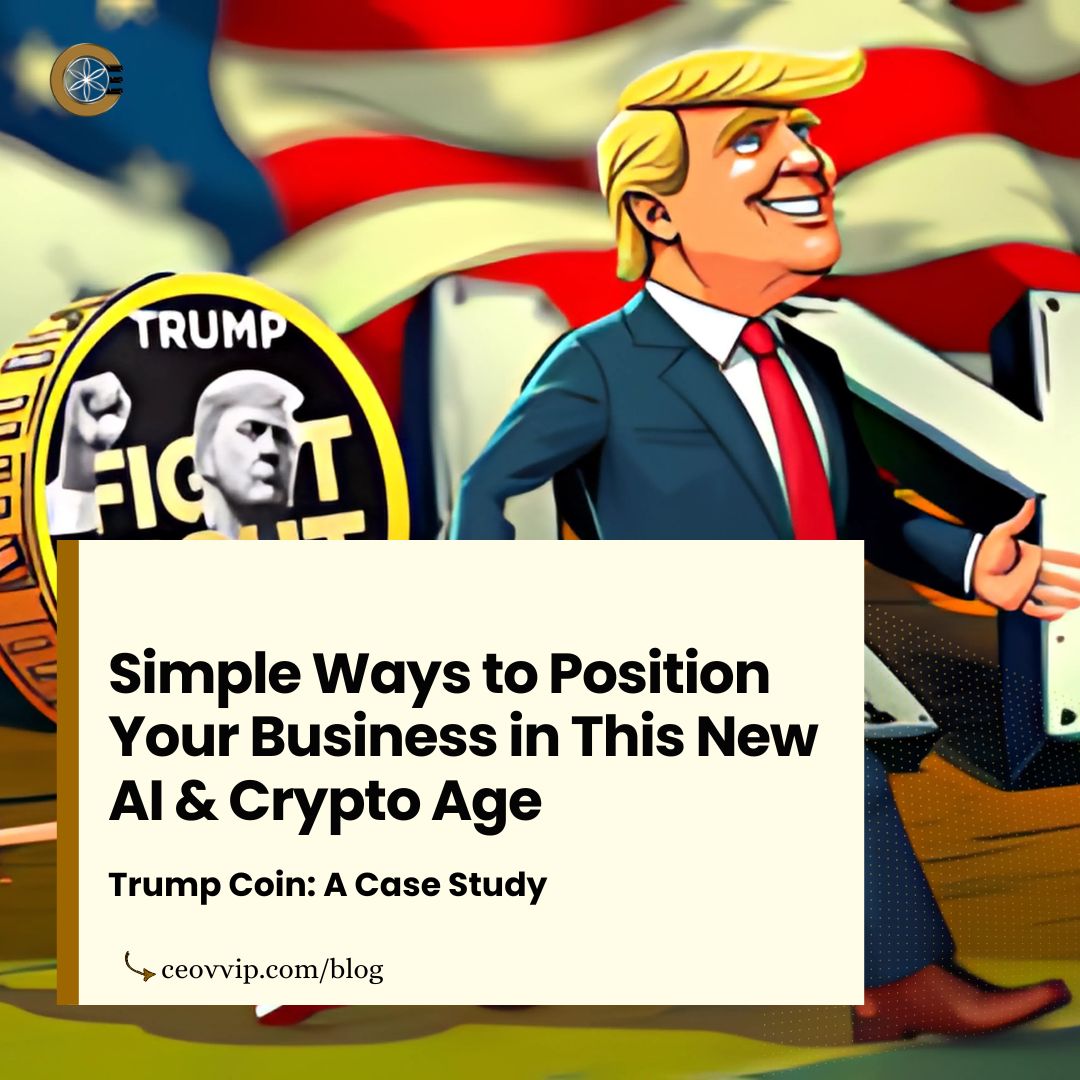
The release of the $TRUMP meme coin just days before Donald Trump’s inauguration in January 2025 provides a fascinating case study for how businesses can strategically position themselves in the ever-evolving AI and crypto landscape. Let’s break this down into actionable insights based on the key elements of this launch.
Let’s explore these game-changing strategies, using the Trump Meme Coin phenomenon as a case study to highlight how you can position your business for success in this AI-and-crypto-fuelled era.
Marry Nostalgia with Innovation: The Power of Storytelling
Timing is everything
Leverage Scarcity and Exclusivity: The Crypto Mindset
Harness AI for Personalisation: Speak Directly to Your Audience’s Soul
1. Marry Nostalgia with Innovation: The Power of Storytelling
What if I told you the key to future-proofing your business lies in the past?
When Trump Meme Coin hit the scene, it wasn’t just another cryptocurrency—it was a symbol. It tapped into a niche audience’s emotions, leveraging nostalgia and loyalty to a polarising political figure. By connecting the crypto world with a tangible story, Trump Meme Coin bridged the gap between the unfamiliar (crypto) and the deeply personal (identity).
The genius lies in the fusion. Consumers don’t just buy products—they buy stories. According to Nielsen, 64% of consumers say shared values are their main reason for building a relationship with a brand. Trump Meme Coin’s story hit that emotional sweet spot.
How to Apply This to Your Business:
Identify what your target audience deeply cares about. Is it community? Legacy? Change?
Create a narrative that intertwines your product or service with those emotions.
Use platforms like TikTok or Instagram Reels to bring this story to life with AI-generated graphics, videos, or relatable memes.
Tools like OpenAI’s DALL·E can help you generate engaging, story-driven visuals that resonate with your audience. Pair those visuals with crypto-based marketing tactics like limited-edition NFT drops to solidify the connection between your narrative and innovation.
2. Timing Is Everything
The $TRUMP coin was strategically launched right before a monumental event—Trump’s inauguration. This demonstrates the power of aligning product launches with significant moments to generate maximum buzz and relevance.
Businesses should time their initiatives to coincide with events or trends that amplify attention and momentum. For example:
In the AI space, aligning a product launch with major industry conferences or breakthroughs in technology can magnify impact.
In crypto, leveraging a bull market or regulatory shifts can create strategic advantages.
By choosing the right moment, your business can ride the wave of public interest and urgency.
3. Leverage Scarcity and Exclusivity: The Crypto Mindset
Why do humans crave what they can’t have? Because scarcity sells.
Within hours, $TRUMP raised billions and saw its value surge by over 300%. This was driven largely by FOMO (fear of missing out) and the speculative nature of cryptocurrency. While crypto is often volatile and speculative, this example shows how scarcity and hype can accelerate adoption.
Businesses can create similar effects by:
Generating exclusivity through limited-time offers, pre-launch waitlists, or tokenized incentives.
Building intrigue by tying their products to futuristic or speculative ideas (e.g., “AI-powered solutions for the next 10 years”).
Inviting customers to be early adopters of something they feel could grow exponentially in value or impact.
How to Apply This to Your Business:
Introduce limited-edition products or services.
Gamify exclusivity. For instance, you could reward early adopters with AI-driven loyalty tokens redeemable for perks.
Use blockchain technology to mint NFTs for your brand, adding an aura of exclusivity to your offerings.
Try using platforms like Ethereum or Binance Smart Chain to create NFTs that represent your product. Highlight the limited nature in all your marketing campaigns—add countdowns or scarcity indicators on your website.
68% of millennial investors in Nigeria have shown interest in crypto assets, according to Statista—meaning this strategy speaks directly to a tech-savvy, future-facing audience.
4. Harness AI for Personalisation: Speak Directly to Your Audience’s Soul
Imagine walking into a store where the salesperson already knows your favourite colour, style, and size—magical, right? AI does this at scale.
The success of Trump Meme Coin wasn’t just about the coin itself; it was about the targeted campaigns that reached its core audience. AI tools like predictive analytics and natural language processing (NLP) played a role in identifying the right demographics and crafting persuasive messages.
Personalisation makes people feel seen and understood. When you pair AI with crypto, you create an ecosystem where your audience feels like co-creators in your business journey, not just customers.
How to Apply This to Your Business:
Use AI chatbots to engage your customers in real-time. Imagine a bot that not only answers FAQs but also recommends products tailored to a customer’s unique preferences.
Integrate AI-powered email campaigns that adapt based on user behaviour. If someone clicks on an email link to a product but doesn’t purchase it, your AI system can send a tailored follow-up with a discount code or more information.
Combine blockchain technology with AI to track customer behaviour and reward them through decentralised loyalty programmes.
Tools like HubSpot’s AI-powered CRM or Nigeria’s Kudi.ai chatbot can help you execute personalised, data-driven marketing strategies.
According to PwC Nigeria, AI adoption in businesses is expected to boost the country’s GDP by 15% by 2030—proof that embracing AI is not optional; it’s essential.
The Trump Meme Coin Lesson: Seize the Future by Staying Bold
The Trump Meme Coin story isn’t about politics—it’s about recognising opportunity and daring to innovate in uncharted territory. It combined the psychological power of nostalgia, the allure of scarcity, and cutting-edge technology to create a product that resonated deeply.
As a business owner in this AI and crypto age, your goal should be to position yourself at the intersection of technology and humanity.
Amplify Emotional and Cultural Resonance
The decision to create a meme coin—a humorous and often controversial form of cryptocurrency—was a bold move. Meme coins are typically fueled by social sentiment and viral culture, rather than traditional value or utility. Despite their controversy, they generate immense emotional engagement.
Takeaway: Businesses should not shy away from tapping into cultural or emotional trends, even controversial ones, as long as they align with their brand. Key strategies include:
Leveraging humour or virality to spark engagement (like memes or trending hashtags).
Aligning products with your audience’s beliefs or aspirations (Trump used his political identity to connect with a fan base).
Creating a polarizing but memorable product that sparks conversations.
In the AI and crypto world, emotional branding can be as crucial as technical innovation.
Acknowledge and Navigate Risks
The $TRUMP coin came with disclaimers that it wasn’t an investment opportunity, despite being in a speculative industry. This balance between tapping into speculative excitement and managing expectations is crucial in industries like crypto and AI, which carry inherent uncertainties.
Businesses need to balance innovation with transparency. Strategies include:
Educating customers on both the benefits and potential risks of your products.
Building credibility through clear disclaimers, robust security measures, and reliable customer support.
Positioning your brand as a trustworthy leader in a speculative market by staying ahead of regulatory and ethical concerns.
Transparency builds trust, especially in cutting-edge spaces where skepticism often exists.
Leverage Massive Market Opportunities
With crypto’s global market cap surpassing $1 trillion and AI projected to contribute $15.7 trillion to the global economy by 2030, the opportunities are enormous. Trump’s ability to generate $13 billion in trading value overnight underscores the potential for businesses to scale rapidly when they align with high-growth industries.
To capitalize on these opportunities:
Invest in research and partnerships to integrate AI or blockchain into your business processes.
Focus on creating scalable solutions that tap into high-demand areas like automation, personalization, or decentralized finance.
Position yourself as a pioneer by adopting innovative technologies early and signalling this to your audience.
As Elon Musk famously said, “Some people don’t like change, but you need to embrace it if the alternative is disaster.”
The tools are at your fingertips, the market is ripe, and the only limit is your willingness to take the leap. So, get creative, stay bold, and let your business ride the wave of AI and crypto to unparalleled success.
At CEOVIP, get your ideas seen and heard by the people who need them.
If you want to Launch your digital products, schedule a VIP Consultation today to work with me and spread your ideas.
Let us handle the tech part while you focus on building your ideas. Buy back time with a system that works.