
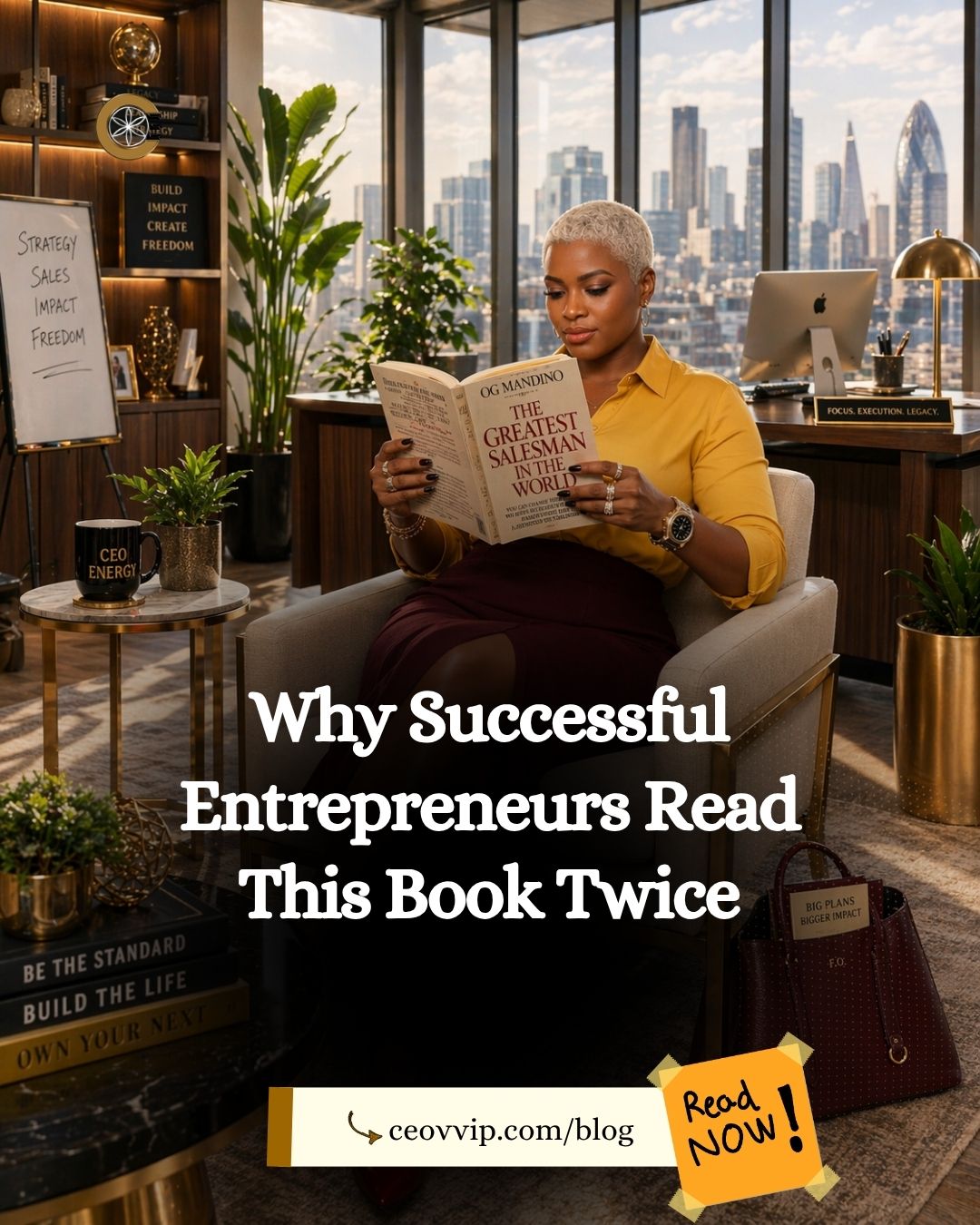
I’ve Read This Book Five Times. It Still Changes Things.
There are books you read once and feel good about. There are books you return to because something in you knows you missed something the first time. And then there are books that reorganise the way you see yourself in relation to your work, not loudly, not all at once, but quietly and permanently.
Og Mandino’s The Greatest Salesman in the World is the third kind.
I have read it five times. Each reading gave me something different, a new idea, a new angle, a sharper sense of responsibility. Not because the text changed, but because I did. What you are able to receive from a piece of wisdom is always a direct reflection of where you are when you encounter it.
I want to share what this book has given me as a businessperson. Not as a summary, but as a set of principles I now work with. If you are a coach, consultant, creator, or entrepreneur who has ever felt the friction between knowing what to do and actually doing it with any consistency, this may be your sign to slow down and read this carefully.
The First Lesson: You Are Not Replicable
One of the earliest things Mandino establishes is the radical uniqueness of every human being. Since the beginning of recorded time, there has never been another person who sees exactly what you see, thinks exactly as you think, or carries precisely the combination of experience and perspective that you carry.
This is not flattery. It is a commercial argument.
The entrepreneur who truly internalises this stops trying to replicate what someone else built and starts building from what only they can offer. For Nigerian and West African business owners, especially people who carry enormous cultural intelligence, lived market knowledge, and community depth, this matters enormously. Your specificity is not a limitation. It is your positioning.
The business that tries to be like everyone else will always compete on price. The business built from genuine personal distinction creates its own category.
The Second Lesson: Persistence Is a Decision Made Before the Day Begins
Mandino’s scrolls return again and again to the theme of persistence, not as a motivational concept but as a practical operating principle. The decision to persist must be made in advance, not in the moment when things become difficult.
This is something most business advice completely misses.
We talk about resilience after the fact. We say things like “keep going” when someone is already exhausted. What Mandino understood is that you must build the commitment to continue before you encounter the friction. This is why daily ritual, daily affirmation, and daily intention setting are not soft habits. They are structural business practices.
If you are waiting until a difficult client conversation or a quiet sales month to decide how committed you are to your work, you are already behind. The decision must live upstream.
The Third Lesson: Emotional Mastery Is a Business Skill
Here is where Mandino becomes genuinely useful in ways modern business content rarely is.
He writes about the circle of moods, the natural fluctuation of human emotion, and makes the observation that weak people allow their thoughts to control their actions, while those who build lasting things learn to master their emotional state so that the work continues regardless.
This does not mean suppressing feelings. It means refusing to allow temporary emotional weather to determine whether you show up, create, communicate, or sell.
For coaches and consultants who run personal brands, this is critical. Your mood is not private. It bleeds into your content, your client relationships, your proposals, and your pricing conversations. The person who shows up inconsistently, full of energy one week, absent the next, is communicating something to their audience even when they think they are saying nothing.
Emotional mastery is not a spiritual luxury. It is what makes your brand feel reliable.
The Fourth Lesson: Laughter and Lightness Are Strategic
Mandino dedicates an entire scroll to laughter, to the idea that joy lengthens life, softens difficulty, and restores proportion. He writes that with laughter, all things return to their proper size.
This is worth sitting with in a business context.
The entrepreneur who takes every setback with devastating seriousness burns out. The one who can hold failure lightly enough to laugh at it, learn from it, and move through it without drama, that person compounds. They try more. They recover faster. They stay in the game long enough for momentum to build.
There is a particular kind of Nigerian entrepreneur energy that carries this naturally, the ability to turn a difficult situation into a story, to find the absurdity in a frustrating client, to laugh at the chaos of building something real. That energy is not unprofessional. It is actually what sustains long careers.
The Fifth Lesson: Dreams Without Execution Are Decoration
The most commercially sharp line in the entire book, across all my readings, is this: dreams are worthless, and plans are of no value unless they are followed by action. Mandino is not romantic about this. Action is not just the final step, it is the thing itself. It is the food and drink that nourish success.
Every coach who has never launched their programme. Every consultant who has been refining their offer for two years. Every creator who has been “getting ready” since last December. This is who Mandino is writing to.
The conditions will never be perfect. The timing will never be ideal. The fear does not disappear before you begin; it disappears because you begin. Acting without hesitation is not recklessness. It is the only way through.
What These Five Readings Have Done for My Business
Each time I return to this book, I find myself more willing to claim my own irreplaceable value, more committed to building systems that hold even when my emotional weather is poor, more comfortable with the pace of real growth, and less patient with the kind of preparation that is actually just delay dressed neatly.
The greatest salespeople, the greatest consultants, the greatest coaches are not the most polished or the most followed. They are the ones who decided, before the difficulty arrived, that they would persist. That they would act. That they would build something that outlasts a bad month.
That decision is available to you right now.
If you are ready to stop preparing and start executing, the 7-Day Launch Challenge will give you the structure to turn what you already know into a live offer in seven days.
👉 Start The 7-Day Launch Challenge – How to Use AI To Launch Your Ebook, Masterclass or Course in 7 Days https://ceovip.eo.page/7daylaunchchallenge

👉 Start The 7-Day Launch Challenge — How to Use AI To Launch Your Ebook, Masterclass or Course in 7 Days.
https://ceovip.eo.page/7daylaunchchallenge
Watch now: Law of Attraction- How the Law of Vibration Changes Everything
Related Posts:
Why Your Genius Deserves to Be Seen: How CEOVIP Can Turn Your Ideas Into Impact, Visibility, and Sales
Law of Mentalism
Momager No.1 | Yoruba Review of Air on Amazon Prime

Read Now: The ‘One Day’ Lie: Why Waiting to Launch Is Keeping You Stuck


Still Feeling Stuck? Let’s Talk About It
Sometimes, it’s not your idea. It’s your system.
Let me help you see what’s missing and unlock what’s working.
Book a call with me. We’ll go through your content and systems together.
Because you didn’t start this business to feel burnt out.
You started it to be in demand.
To be paid well.
To be known.
It’s time your business reflects that.


Leave a Reply
You must be logged in to post a comment.